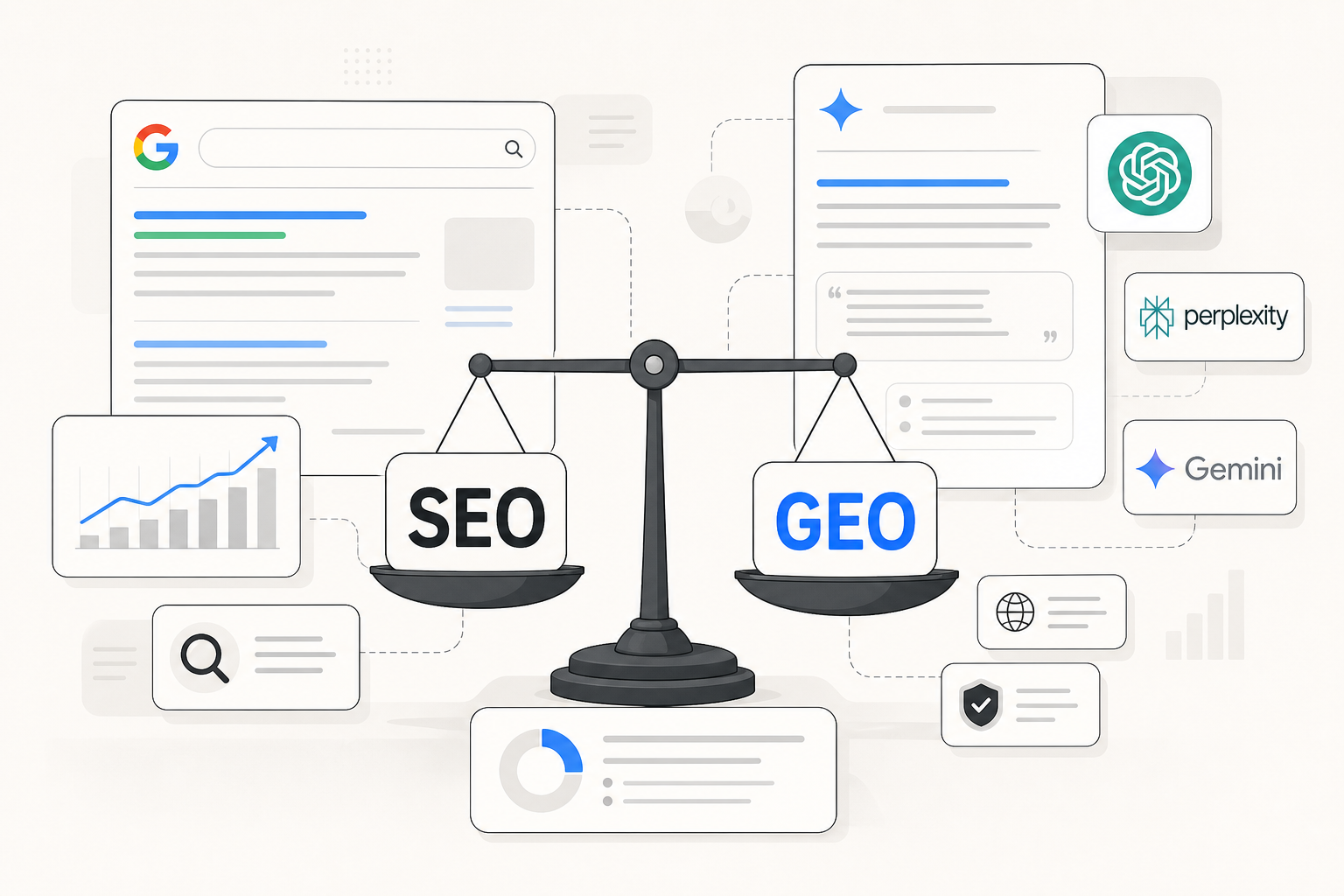
Roughly 60% of Google searches now end without a click, but AI-driven search visitors are converting at 4.4 times the rate of traditional organic traffic. The shift from ranking to synthesis doesn't mean SEO is dead, it means the plumbing has changed. Here is how to balance the transition without losing your foundation.
The search landscape of 2026 is no longer a simple race to the top of a blue-link list. We are seeing a fundamental shift in how information is consumed and how businesses reach their audience. Traditional search engines like Google still drive massive volume, with roughly 5 trillion searches annually, but generative platforms like ChatGPT, Perplexity, and Gemini are rapidly siphoning off informational and technical queries. In fact, Gartner predicts a 25% drop in traditional search volume by the end of 2026.
If you want to maintain visibility and keep your traffic flowing, you need to understand the evolving relationship between traditional Search Engine Optimization (SEO) and the emerging discipline of Generative Engine Optimization (GEO). This guide will help you navigate the "Zero-Click Crisis" and build a hybrid strategy that wins in both traditional and AI-driven search environments.
What are SEO and GEO?
To balance your strategy, you first need to define the two pillars that now govern digital visibility. Search Engine Optimization (SEO) remains the foundation for organic growth. It is the practice of optimizing your website to rank in traditional search engine results pages (SERPs). The core goal of SEO is to drive clicks and direct traffic to your site by matching specific keywords and searcher intent with high-quality content.
Generative Engine Optimization (GEO) is a newer discipline that focuses on optimizing your content to be included, synthesized, and cited in AI-generated responses. When a user asks a complex question to an AI model, the engine doesn't just provide a list of links. It reads the web, summarizes the best information, and presents a direct answer. GEO is about ensuring your brand's expertise is what the AI trusts to build that answer.
Key differences in the SEO vs. GEO balance
The primary difference lies in the ultimate objective. While SEO focuses on ranking pages and driving clicks, GEO is about powering answers and earning the citations that validate them. Here is the short version of how they differ:
- SEO: optimized for algorithms that prioritize page-level authority, backlinks, and keyword placement.
- GEO: optimized for large language models (LLMs) that prioritize semantic clarity, factual density, and source attribution.
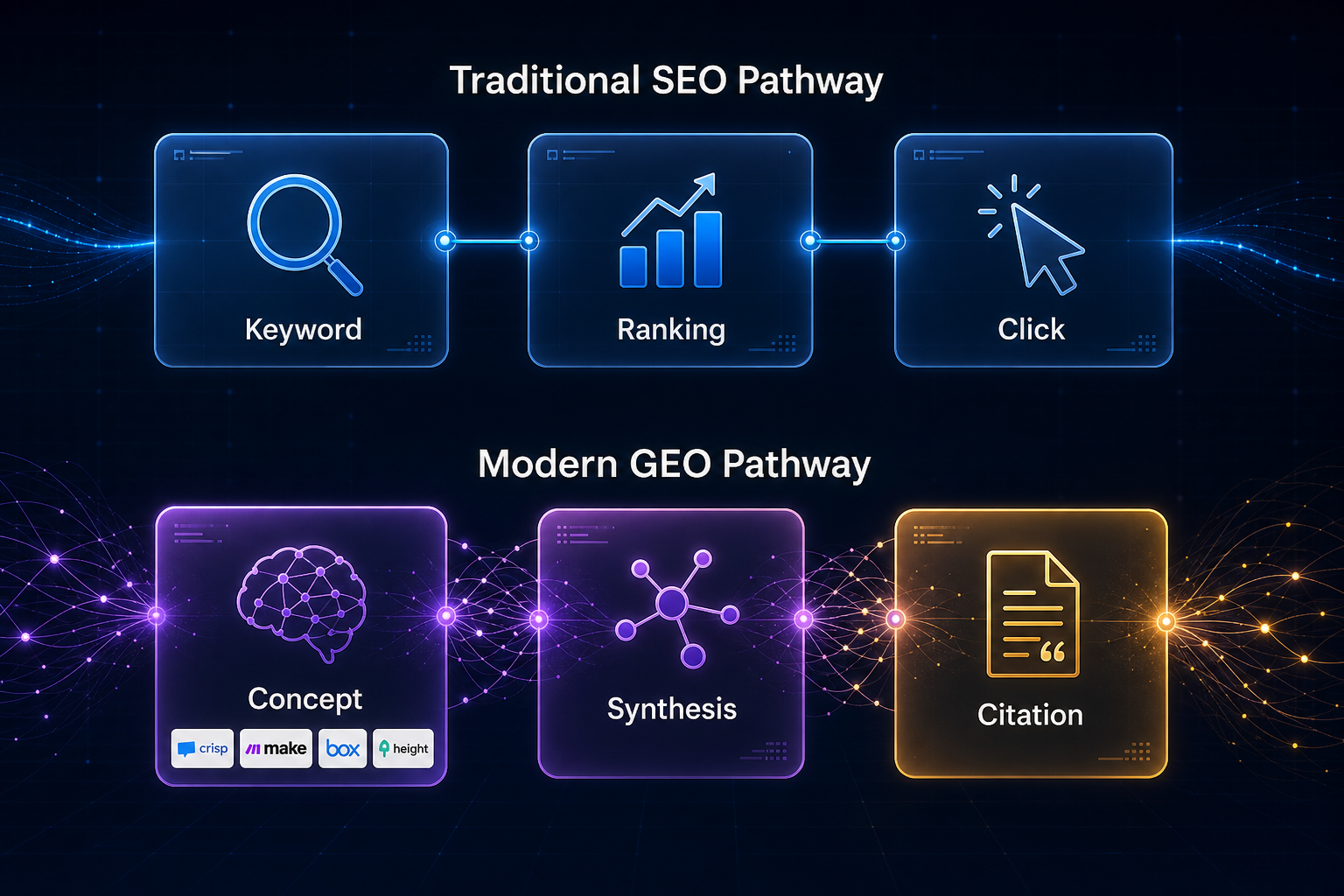
Despite these differences, they are not competing strategies. A hybrid strategy is the most effective approach for 2026. In this model, your traditional SEO work creates the high-quality, authoritative content that generative engines use as their primary source material.
The rise of zero-click search in 2026
The "Zero-Click Crisis" has reached a tipping point this year. Recent data indicates that nearly 60% of searches in the U.S. now end without the user ever clicking through to an external website. This phenomenon is largely driven by the expansion of AI Overviews (SGE), which provide immediate, comprehensive answers directly on the search results page.
For many users looking for quick facts or simple explanations, the AI overview is "good enough." They get what they need without clicking a single blue link. This has caused a significant drop in click-through rates (CTR) for informational queries that were once the bread and butter of content marketing.
Why conversion is higher in the SEO vs. GEO era
However, focusing solely on click volume misses a critical change in visitor quality. While overall clicks may be down, the visitors who do arrive at your site via AI citations are significantly more valuable.
| Metric | Traditional Organic Search | AI-Driven Search |
|---|---|---|
| Click-Through Rate (CTR) | Declining for informational queries | Lower overall, but highly targeted |
| Conversion Rate | 1.0x (Baseline) | 4.4x (Higher commitment) |
| Search Volume Trend | Stable to declining in some niches | Growing exponentially in 2026 |
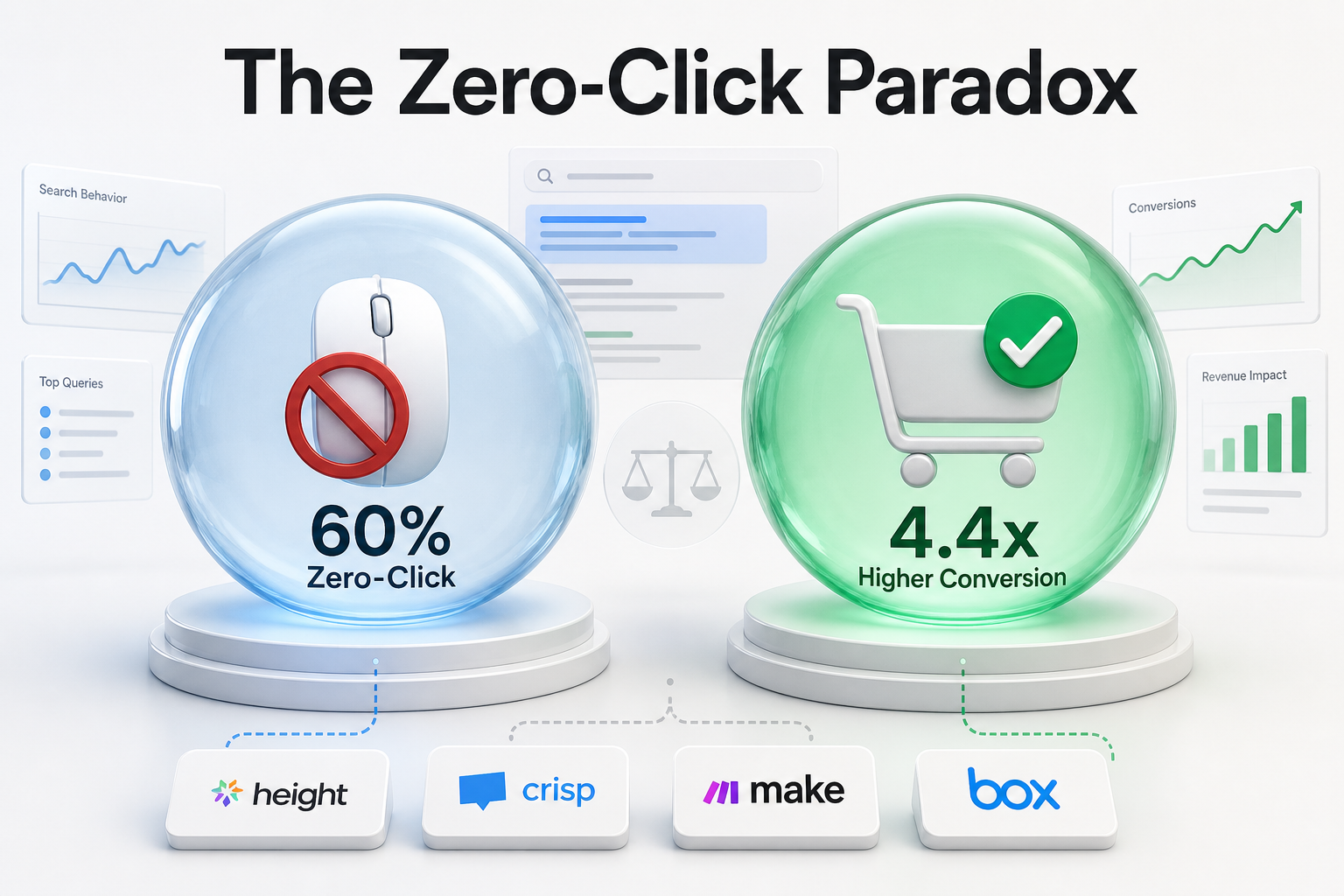
The reason for this disparity is simple: intent. Users who interact with an AI engine are often engaging in deep research or complex decision-making. By the time they click a citation to visit your site, they have already been partially convinced by the AI's summary of your content. They arrive more committed to a decision or a purchase than a user who is just clicking on the first blue link they see.
Core components of a GEO-ready site
Transitioning your site to be GEO-friendly requires a fundamental shift in how you produce content. You can't just "stuff" keywords and expect an AI to cite you.
Semantic clarity and conceptual mapping
The first major component is semantic clarity. AI models don't just look for keyword matches, they are designed to understand concepts, entities, and relationships. This means you need to move beyond simple keyword density and focus on defining concepts in natural, clear language. Use descriptive headings that state exactly what the section is about, and use the first sentence of each paragraph to state a clear fact or claim.
Structure over stuffing
The second component is choosing structure over stuffing. Generative engines have a strong preference for content that is easy to extract. This includes:
- Well-organized tables: for comparing products, prices, or specifications.
- Bulleted lists: for distinct options, benefits, or steps.
- Clear heading hierarchies: using H2, H3, and H4 to nest information logically.
If your most important data points are buried in the middle of a 400-word paragraph, there is a high chance the AI will miss them when generating a summary.
E-E-A-T and factual density
Finally, E-E-A-T (Experience, Expertise, Authoritativeness, and Trustworthiness) has become the primary filter for AI inclusion. To be cited, your content must be backed by verifiable data and authoritative citations. AI models are increasingly trained to avoid "hallucinations" by prioritizing sources that provide clear evidence for their claims.
One of the most effective technical ways to help AI engines interpret your content is through comprehensive schema markup. Schema provides the technical plumbing that allows AI to understand exactly what your page is about. We recommend using our Schema Markup Generator to build these JSON-LD tags. It ensures your entity relationships (like the connection between a product and its price) are explicitly defined.
How AI engines select their sources
A unique phenomenon we have identified in 2026 is what some call the "Citation Anomaly." In traditional SEO, if you aren't in the top three results, you barely exist. But in generative search, the rules are different. Data shows that ChatGPT cites pages in positions 21 or lower nearly 90% of the time.
This tells us that AI engines prioritize the relevance, uniqueness, and "extractability" of an answer over the traditional domain authority signals that Google uses to rank its top 10. To win in this environment, you need to create "citation bait." This means publishing:
- Unique statistics: from your own internal data or surveys.
- Proprietary research: that provides a new perspective on a topic.
- Highly specific facts: that provide a definitive answer to a complex question.
When an AI engine needs a specific data point to complete a summary, it will go looking for the original source of that fact, even if that site is not a "giant" in the industry.
Brand consistency across the knowledge graph
Another critical factor is brand consistency. Generative engines build a "Knowledge Graph" of your company based on mentions across the entire web. You must ensure that your entity information (your company name, key leadership, location, and core services) is identical across your website, LinkedIn, Wikipedia, and industry directories. If there are discrepancies, the AI may view your brand as less trustworthy.
How we evaluated the leading AI search engines
To understand the search vs. GEO balance, we looked at the current capabilities of the major players. Here is what we found:
- ChatGPT Search: prioritizes real-time info and citations from a broad web index.
- Claude (Anthropic): excels at deep analysis and reasoning over complex documents.
- Perplexity: focuses on synthesizing answers from verified, premium data sources.
- Google AI Overviews: leverages the massive Google Shopping Graph and local data.
Comparison of major AI search engines in 2026
| Engine | Primary Model | Search Capability | Best For |
|---|---|---|---|
| ChatGPT Search | GPT-5.5 (Thinking/Pro) | Real-time web search with citations | General research and conversational tasks |
| Claude | Opus 4.7 / Sonnet 4.6 | Real-time browsing and artifacts | Deep analysis and coding workflows |
| Perplexity | Model Council (Gemini/GPT/Claude) | Synthesized answers with premium data | Verified facts and professional research |
| Google AI Overviews | Gemini (Integrated) | SERP-embedded snapshots | Quick informational queries and shopping |
🎥 Demo: Claude's interface excels at synthesizing complex data points from across the web into actionable business insights.
AI engine pricing plans (2026)
| Plan | ChatGPT (OpenAI) | Claude (Anthropic) | Perplexity AI |
|---|---|---|---|
| Free | $0 (Limited search) | $0 (Standard caps) | $0 (Standard search) |
| Individual Pro | $20/mo (Plus) | $20/mo (Pro) | $17/mo (Annual) |
| Power User / Max | From $100/mo (Pro) | From $100/mo (Max) | $167/mo (Max) |
| Team / Business | $25/user (Business) | $25/seat (Team) | [Personal Use Only] |
🎥 Demo: Perplexity AI acts as a sophisticated answer engine, synthesizing real-time web data into cited, factual responses that bypass traditional search results.
The hybrid SEO/GEO workflow
How do you actually manage this transition without doubling your workload? We recommend a four-step hybrid workflow that leverages technical tools to automate the "plumbing" of both search and generative optimization.
Step 1. Audit for semantic gaps
You cannot optimize what you haven't analyzed. Use our SEO Analyzer to perform a site-wide health check. Specifically, you should look for pages with thin content or sections that are too vague for an AI to summarize accurately.
Pro tip: Use the "Content Density" report in the Analyzer to find paragraphs that exceed 6 sentences. These are often candidates for being broken into bullet points or tables to improve "extractability."
Step 2. Optimize for extraction
Once you have identified your high-priority pages, move your most important data points into structured formats. Convert long lists into tables and ensure your key conclusions are "front-loaded" at the top of your headings.
Bottom line? If an AI can't find your answer in the first 100 words of a section, it will likely move on to a competitor's site that presents the fact more clearly.
Step 3. Build authority off-site
GEO is heavily influenced by how the rest of the web talks about you. Focus on digital PR and active participation in industry forums like Reddit and Quora. Generative engines often use these platforms to gauge "human sentiment" and real-world recommendations.
If your brand is consistently mentioned as a helpful solution in these spaces, you are much more likely to earn a citation in an AI answer. We have seen that AI models often prioritize Reddit threads for "opinion-based" queries (e.g., "What is the best SEO tool for small business?").
Step 4. Use specialized tools for competitive intel
Don't guess which of your competitors are winning the GEO race. We offer a URL Extractor that can bulk analyze which links are being cited by AI engines and search snapshots.
By extracting the source lists from top AI answers, you can identify the exact content structures and data points that the engines are currently favoring in your niche. If you see that your competitors are all using tables to describe their features, you should probably do the same.
Measuring success in the AI era
Measuring success in the search vs. GEO balance used to be simple: track your rank for a keyword and watch the traffic grow. In the AI era, those metrics are only half the story.
Tracking brand mention frequency
You need to start tracking "Brand Mention Frequency" to see how often your brand is included in synthesized answers. This is a measure of your "mental availability" in the LLM's world. Even if you don't get a direct click, being mentioned as a leading solution builds massive brand authority.
Monitoring citation rates
We also recommend monitoring your citation rates within the AI tools themselves. Regularly run conversational queries in Perplexity or ChatGPT to see if your site is being cited for its unique data points. If you see your citations dropping, it's a sign that a competitor has published more recent or more structured data.
The role of prompt mapping
Finally, use "Prompt Mapping" to understand the different ways users ask about your products. This helps you identify the specific natural language phrases you should be optimizing for. For example, users might ask "how to balance SEO vs. GEO" differently than they would search for "SEO vs GEO comparison." Mapping these conversational prompts allows you to tailor your H3 and H4 headings to match actual user questions.
Start balancing your search strategy today
The move toward AI-driven search doesn't mean you should abandon traditional SEO. Instead, it means you need to build better plumbing. By combining high-quality content with the technical structures that AI engines crave, you ensure your brand remains visible no matter where your audience starts their search.
Whether you are trying to rank for a "best of" list or get cited as a technical authority, the principles remain the same: be clear, be structured, and be verifiable. Reclaiming your lost visibility in the age of AI is not about working harder, it's about working smarter with the data you already have.
Take the first step in preparing for the AI shift. Audit your site's health with our SEO Analyzer to find your semantic gaps and ensure your content is ready for the GEO shift. By focusing on clarity, structure, and authority, you can turn the "Zero-Click Crisis" into a significant competitive advantage.
Frequently Asked Questions
What is the main difference between SEO vs. GEO for businesses in 2026?
Traditional SEO focuses on ranking pages and driving clicks from search results, while GEO (Generative Engine Optimization) focuses on being included and cited in AI-synthesized answers. In 2026, the best approach is a hybrid strategy that balances both.
How does the SEO vs. GEO shift impact my website traffic?
You may see a decrease in overall clicks for informational searches as AI Overviews provide direct answers. However, users who click through from an AI citation often have a conversion rate 4.4 times higher than traditional organic search visitors.
Which tools are best for an SEO vs. GEO hybrid strategy?
We recommend the SEO Analyzer for finding semantic gaps and our Schema Markup Generator for creating the JSON-LD structure AI engines need. You can also use our URL Extractor to analyze which competitor sources are being cited by generative engines.
Why is schema markup so critical in the SEO vs. GEO landscape?
Schema markup provides a technical bridge that helps AI engines understand the entities and relationships on your page. By explicitly defining your data, you make it significantly easier for AI models to extract and cite your information accurately.
Will the SEO vs. GEO transition make traditional search engines obsolete?
No, traditional search volume remains massive, but the intent is shifting. Traditional SEO will still drive your volume, while GEO will drive your highest-intent leads. Balancing both is the key to maintaining a healthy search presence in 2026.
How can I track my performance during the SEO vs. GEO transition?
You should track Brand Mention Frequency and citation rates in tools like ChatGPT and Perplexity. Measuring how often your brand appears in AI-generated answers is just as important as tracking traditional keyword rankings in 2026.
What is 'citation bait' in an SEO vs. GEO strategy?
Citation bait refers to unique statistics, proprietary facts, or expert quotes that are highly 'extractable' by AI models. By providing definitive answers to specific questions, you increase the likelihood that an AI engine will cite your site as a source.
🤖 Future-Proof Your Search Strategy
Use our free SEO Analyzer and Schema Markup Generator to make your site AI‑ready and GEO‑optimized.
Start Free SEO Audit →© 2026 SEO Faston Pro — Balancing SEO and GEO for the AI‑driven future.