
UEFA Champions League Groups Explained: How to Read the Standings on Faston
The UCL no longer uses groups – it’s a single 36-team league table. Here’s how to read the standings, understand tiebreakers, and follow it all on Faston.
June 19, 2026 · 8 min read

TL;DR
The UEFA Champions League scrapped its traditional group stage in 2024/25. There are no longer eight groups of four teams – instead, all 36 clubs sit in a single league table and play eight different opponents each. Top 8 qualify directly for the round of 16. Places 9-24 go to a two-legged play-off. Places 25-36 are out. Sixteen points almost guarantees a top-8 finish; 10 points usually locks in a play-off spot. Tiebreakers go: goal difference, goals scored, away goals, wins, away wins. You can track every position, live, at Faston.
People still search for “Champions League groups” – and we get it, the format ran for over 20 years. But since the 2024/25 season, the groups are gone. What replaced them is better for fans in almost every way, but it also makes the standings table look very different from what most of us grew up reading.
This guide walks through exactly what changed, how to read the new table correctly, what the column headers actually mean, and how to follow every position live on Faston.
From groups to one big league table
For most of its modern history, the Champions League group stage worked like this: 32 teams, split into eight groups of four. You played each group opponent twice – once at home, once away – six matches total. The top two in each group went through. Clean, simple, familiar.
UEFA scrapped it ahead of 2024/25. The new format – called the league phase – puts all 36 participating clubs into a single unified table. No groups, no sub-divisions. Every team plays eight matches, each against a different opponent (four at home, four away). Results are pooled into one ranking that determines who goes where.
The immediate effect: you can have a situation where Real Madrid and Bayern Munich are in the same “group” by default, because everyone is in the same group. That fixture, which used to require a knockout draw to happen, can now show up in the league phase itself. More big games, earlier in the competition.
How to read the standings table
Open the UCL standings on Faston on any league phase matchday and you’ll see a table with familiar column headers: P (played), W (won), D (drawn), L (lost), GF (goals for), GA (goals against), GD (goal difference), Pts (points).
Three points for a win, one for a draw, zero for a loss – no change there. What changed is what the position in that table means.
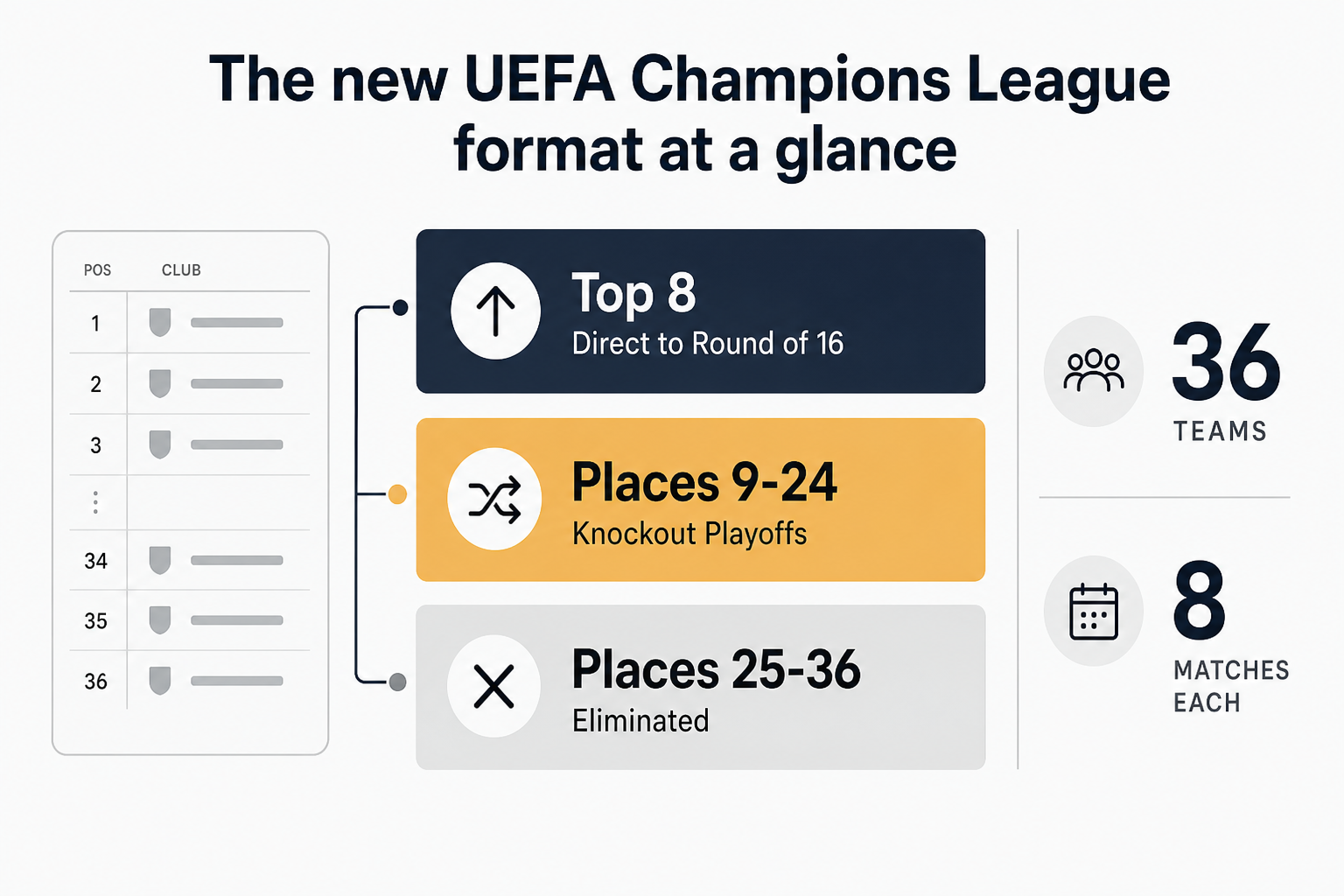
The table has three zones, and most live standings displays (including Faston’s) colour-code them:
| Position | Zone | What it means |
|---|---|---|
| 1st – 8th | Direct qualification | Straight to the round of 16 |
| 9th – 24th | Play-off qualification | Two-legged play-off to reach last 16 |
| 25th – 36th | Eliminated | Out of Europe entirely (no Europa League drop-down) |
That last row is worth underlining. Under the old format, group-stage elimination still meant a consolation run in the Europa League knockout rounds. That safety net is gone. Finish 25th or lower and you’re done – full stop.
How many points do you actually need?
With 36 teams playing a different number of opponents (none of the eight scheduled fixtures are against the same team), the exact points threshold for each zone shifts depending on how results play out across matchdays. But Opta’s simulations across 50,000 season scenarios give us reliable benchmarks:
To finish top 8 (direct last 16):
- 16 points – almost certain
- 15 points – strong chance (73% of simulations)
- 14 points – unlikely
To finish top 24 (play-off spot):
- 10 points – almost certain
- 9 points – reasonably safe (69% of simulations)
- 8 points – risky (only works in 16% of simulations)
Put simply: five wins from eight games (15 pts) usually gets you into the last 16 automatically. Three wins (9 pts) usually gives you a play-off fight. Two wins (6 pts) and you’re probably watching the knockout rounds from home.
The tiebreaker rules, explained clearly
When two or more teams finish on equal points after all eight league phase matchdays, UEFA applies these criteria in order until the tie is broken:
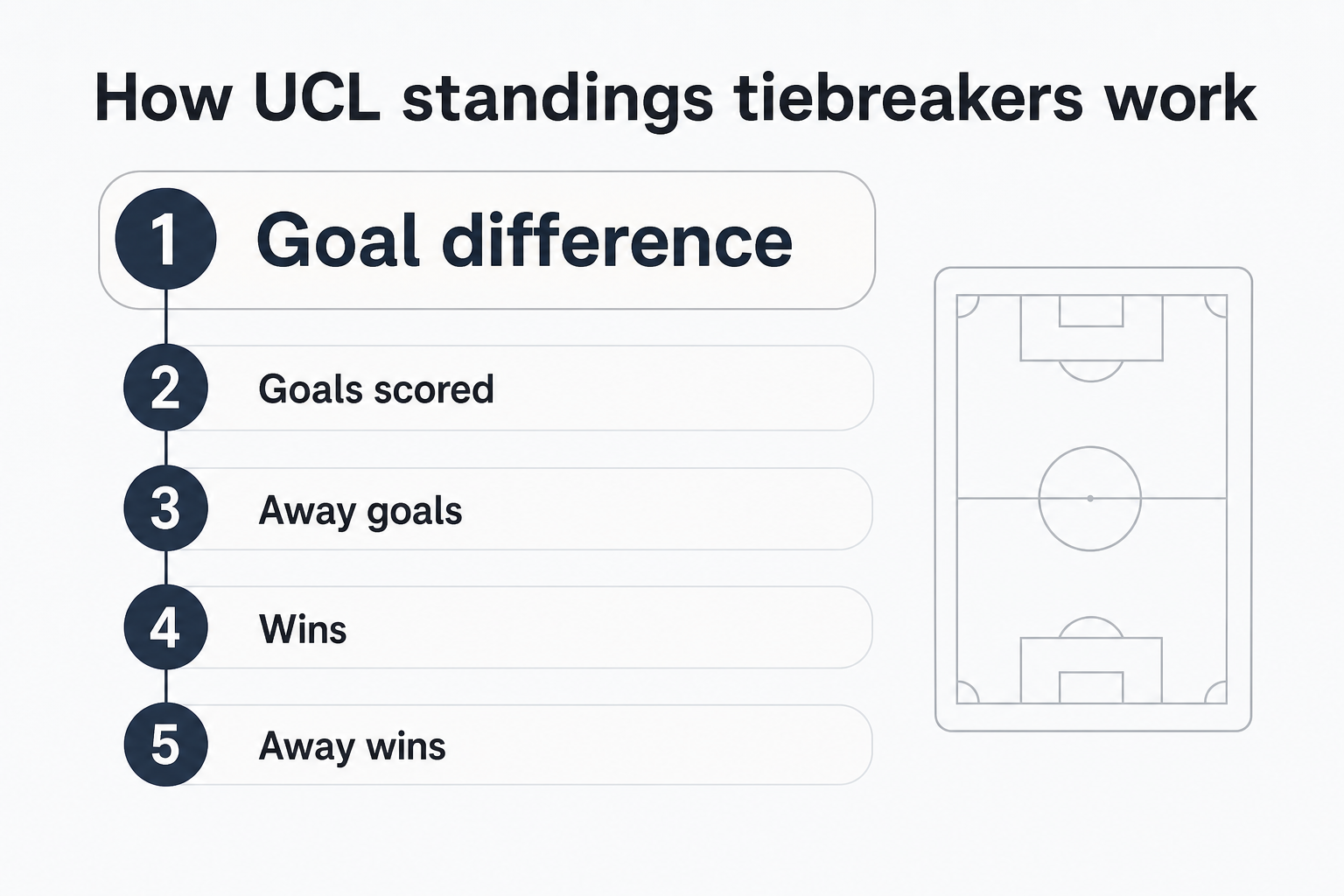
- Goal difference across all league phase games
- Goals scored across all league phase games
- Away goals scored across all league phase games
- Number of wins across all league phase games
- Number of away wins across all league phase games
If teams are still tied after all five: UEFA moves to criteria involving collective opponent performance – essentially, how strong were the opponents each team beat or drew with. And if that’s still tied: club coefficient (UEFA’s ranking of clubs based on their recent European results), which is used as the final tiebreaker.
The practical takeaway: goal difference and goals scored are what matter most in a close table. If your team and a rival are on the same points heading into the final matchday, goals matter. A team that grinds 1-0 wins is in a far more precarious position than one that’s been winning 3-0.
“Every game counts. Any result has the potential to dramatically change a team’s position, right up to and including the very last matchday.”
Position matters – even within the top 8
Finishing in the top 8 used to simply mean “seeded in the last 16 draw.” Not anymore. Under a rule introduced with the 2025/26 season, where you finish inside the top 8 shapes your path through the knockouts:
- Top 4 finishers: Earn home second legs in both the round of 16 and the quarter-finals
- Top 2 finishers: Also earn the home second leg advantage in the semi-finals
So a team in 1st has a structural knockout advantage over a team in 8th, even though both have the same “direct R16” label. Over a three-round run to the final, that’s three home legs versus potentially zero. It matters.
How the play-off round works (positions 9-24)
Teams finishing 9th to 24th enter a two-legged knockout play-off. The draw is seeded by league phase position: 9th plays 24th, 10th plays 23rd, and so on. The higher-finishing team is not automatically given a home second leg by default – that’s determined separately.
Eight ties. Eight winners advance to the round of 16, where they meet the top-8 finishers.
Following it live on Faston
The fastest way to track who’s where during a Champions League matchday is a live scores site that updates standings in real time. Faston does exactly that – live scores, real-time league tables, and fixtures across all major European competitions including the UCL, updated as goals go in.
During a live matchday, the positions on the table shift mid-game as results change across different stadiums. A team sitting 9th could jump to 7th on the basis of a single goal at another venue. Faston surfaces those changes as they happen, so you’re not refreshing Wikipedia or the UEFA app to see where things stand.
The site’s clean, readable layout makes the qualification zones easy to parse at a glance – exactly what you want when six games are happening simultaneously and position 8 could be three different teams depending on which final scores land.
Try Faston
Faston is a live football scores and standings platform built for fans who want real-time data without the noise. Whether you’re tracking a Champions League matchday or checking where your team sits in the league table, Faston keeps the numbers current.
Head to faston.click to follow the next Champions League matchday live.
Frequently Asked Questions
Does the Champions League still have groups?
No. Starting from the 2024/25 season, the UEFA Champions League replaced its traditional group stage with a single 36-team league phase. All 36 clubs are ranked in one unified table, with each team playing eight matches against different opponents.
How many teams qualify from the Champions League league phase?
Twenty-four teams advance from the league phase. The top 8 qualify directly for the round of 16, while clubs finishing 9th to 24th enter a two-legged knockout play-off. Teams finishing 25th to 36th are eliminated entirely.
How many points do you need to reach the Champions League round of 16?
According to Opta’s simulations, 16 points almost certainly secures a top-8 finish and direct progression to the last 16. 15 points gives a strong chance, while 14 points is unlikely to be enough.
What are the tiebreakers in the Champions League standings?
When teams are level on points at the end of the league phase, UEFA applies these criteria in order: (1) goal difference, (2) goals scored, (3) away goals scored, (4) number of wins, (5) number of away wins. If still equal, further criteria including collective opponent points and club coefficient are used. Full details are on the UEFA tiebreakers page.
Where can I follow Champions League standings live?
You can follow live Champions League standings, scores, and fixtures at Faston. The site provides real-time scores and league tables across all major European competitions including the UCL, updated throughout every matchday.