
Opta Football Predictions for FIFA World Cup 2026: The Supercomputer’s Complete Guide
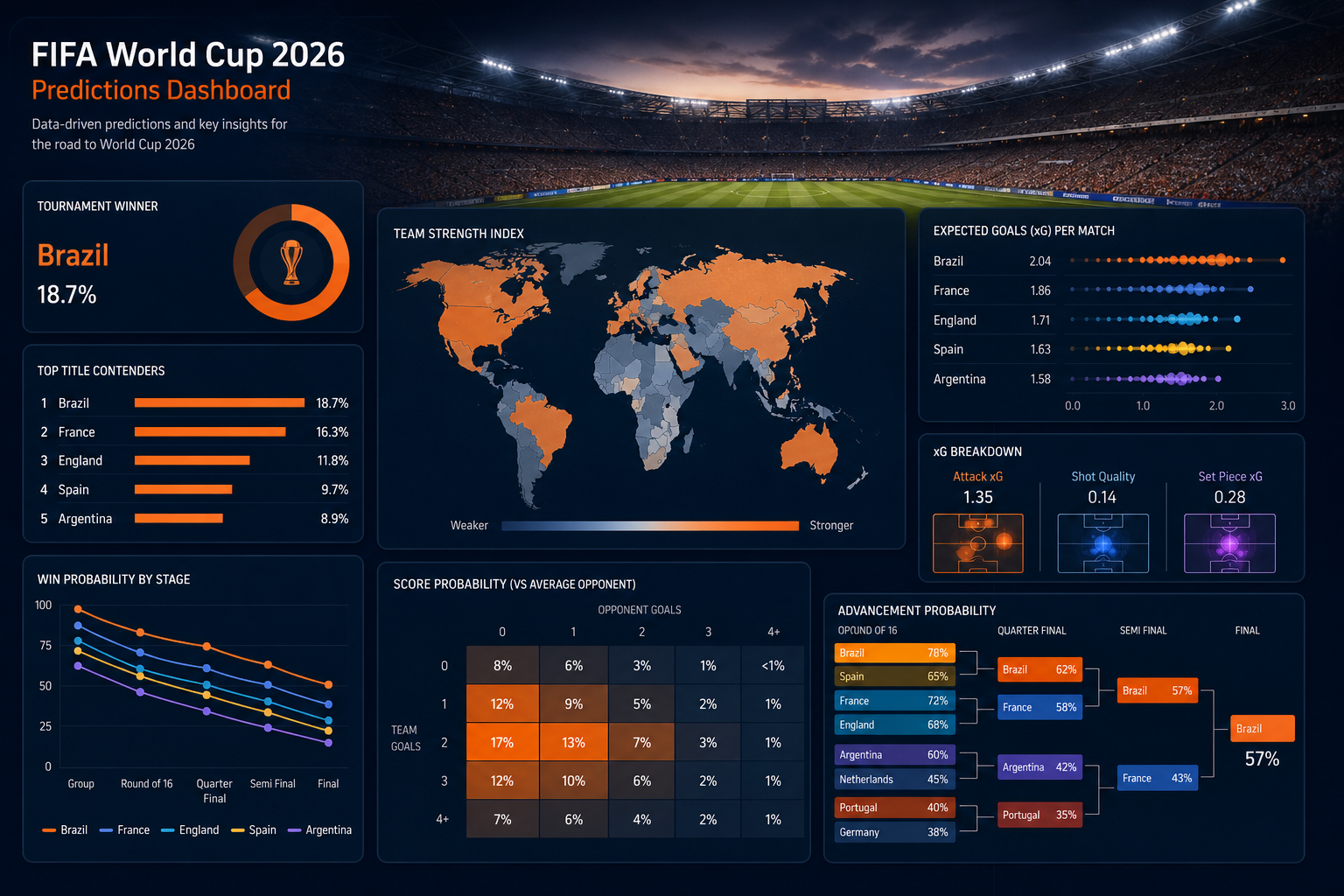
The 2026 FIFA World Cup has entered its most exciting phase. With 48 nations starting the journey across the United States, Canada, and Mexico, only a handful remain standing – and one of the most closely watched analytical tools throughout the tournament has been the Opta Supercomputer. Here is a deep dive into what Opta’s football predictions mean for FIFA World Cup 2026, how the model works, which teams it favours, and how accurate its projections have been.
What Is the Opta Supercomputer?
Opta, operated by Stats Perform and published via The Analyst (theanalyst.com), is the gold standard for football data. The Opta Supercomputer is a league and tournament prediction model built on decades of match data. Rather than relying on gut feeling or pundit opinion, it runs 25,000 simulations of every remaining game in the competition every time an update is triggered.
How the Model Works
- Betting market odds are combined with the Opta Power Rankings – a strength-of-team metric based on historical and recent performance.
- The model calculates the probability of each match outcome (win, draw, or loss) for both teams.
- It then simulates all remaining fixtures thousands of times to arrive at probabilities for each team to finish in every possible position.
- After each real-world game ends, the model refreshes. A red card, a comeback win, a shock defeat – all of it is absorbed and the probabilities shift accordingly.
This makes the Opta Supercomputer a living forecast, not a static pre-tournament pick.
Opta’s Pre-Tournament World Cup 2026 Favourites
Before a ball was kicked in North America, the Opta Supercomputer ran its initial 25,000 simulations and published the following champion probabilities:
| Team | Pre-Tournament Win Probability |
|---|---|
| Spain | 16.1% |
| France | ~13% |
| Argentina | ~10-11% |
| England | ~10-11% |
| Brazil | ~8% |
| Germany | ~7% |
| Portugal | ~6% |
| Netherlands | ~5% |
Spain were the outright favourites from the start, on the back of their Euro 2024 triumph and a young, technically dominant squad. France were close behind, with Argentina – as reigning world champions – generating significant model confidence based on their unbeaten run stretching back to 2021.
How the Predictions Evolved Through the Tournament
Group Stage Shocks
The Opta model had to work hard during a group stage that produced several upsets. Germany, Brazil, the Netherlands, and Portugal – all ranked inside the supercomputer’s top eight pre-tournament – were eliminated before the quarter-finals. This is a tournament that has humbled pre-competition models, though Opta’s top four (Spain, France, Argentina, England) all survived.
Notable group stage events that moved the needle:
– Spain’s goalless draw with Cape Verde on Matchday 1 dented confidence slightly, though in hindsight Cape Verde proved to be a credible side (drawing with Uruguay and Saudi Arabia too).
– France’s penalty shootout win over Paraguay in the Round of 16 reduced the model’s confidence in Les Bleus marginally.
– Argentina’s struggles – needing extra-time to beat Cape Verde and a late comeback to beat Egypt – kept their probabilities volatile despite their overall record.
Co-Hosts Eliminated at the Last 16
One of the most significant storylines the model had to absorb: all three co-hosts – the United States, Canada, and Mexico – crashed out at the Round of 16. The USMNT fell 4-1 to Belgium (after Folarin Balogun’s red card), Canada lost 3-0 to Morocco, and Mexico suffered a 3-2 defeat to England.
The supercomputer’s updated numbers reflected the shift in power entirely towards European teams.
Opta Supercomputer Projections at the Quarter-Final Stage
Here are the Opta Supercomputer’s champion win probabilities at the quarter-final stage – after the last-16 results were processed:
| Team | Win the World Cup | Reach the Final |
|---|---|---|
| France | 27.3% | 44.3% |
| Spain | 21.3% | ~38% |
| Argentina | 17.3% | ~30% |
| England | 16.5% | ~28% |
| Norway | 6.6% | ~15% |
| Switzerland | 3.8% | ~8% |
| Morocco | 3.7% | ~7% |
| Belgium | 3.6% | ~6% |
France are the new favourites. The supercomputer moved France above Spain after their performances in the knockout rounds, and by the QF stage they were comfortably the model’s top pick – winning the tournament in more than 1-in-4 simulations.
Why France Are Opta’s World Cup 2026 Favourites
The Opta model’s confidence in France comes down to several compounding factors:
1. Mbappé in Unstoppable Form
Kylian Mbappé entered the quarter-finals with 7 World Cup 2026 goals (before adding three more with a hat-trick against Morocco). The supercomputer factor-weights individual quality against defensive records – and Mbappé’s finishing data is among the highest in the history of the Opta database. A player scoring at 1.4+ goals per 90 minutes in a knockout tournament will always skew the model toward his team.
2. Defensive Solidity
France’s expected goals against (xGA) numbers through the group and R16 stages were among the tournament’s best. The model rewards teams who suppress high-quality chances, and Deschamps’ defensive organisation has been exceptional.
3. Squad Depth
The Opta Power Rankings account for squad strength beyond the starting eleven. France’s bench depth – Camavinga, Coman, Thuram – is virtually unmatched in the remaining field.
Spain: Still Strong, But Fading?
Pre-tournament favourites Spain opened at 16.1% championship probability. By the quarter-finals they had actually seen that rise to 21.3% – simply because so many rivals had been eliminated. But they dropped from first to second as France’s in-tournament numbers overtook them.
The model noted one fascinating defensive record for Spain: goalkeeper Unai Simón had gone longer without conceding a World Cup goal than any goalkeeper in tournament history at the quarter-final stage. Perfect defensive statistics like that do not go unnoticed by Opta’s model – shutouts directly reduce the simulated opponents’ win probabilities.
Spain’s potential semi-final clash with France – should both teams advance from the QF – is flagged by the model as the likely “true final” in terms of quality.
Argentina: Champions Under Pressure
Defending champions Argentina came in at around 17.3% win probability at the QF stage. The model had been repeatedly shaken by their unconvincing results but kept recalibrating on the basis of their extraordinary unbeaten record.
The supercomputer appeared impressed by one factor above all: Argentina’s winning mentality in close games. Squeezing past Cape Verde in extra-time and rescuing a comeback against Egypt are the exact type of low-probability outcomes that a 25,000-simulation model eventually treats as evidence of elite mental fortitude and tactical flexibility.
England: Fourth Favourites but Not Far Off
England were given 16.5% champion probability at the QF stage – third pre-tournament, now fourth. The model had two persistent concerns:
- Right-back vulnerability – with Reece James’ injury and neither Quansah (sent off vs Mexico) nor Djed Spence convincing, the structural weakness in England’s right flank was flagged repeatedly.
- Inconsistency – wins over Croatia (4-2) and Mexico (3-2) at the Azteca were positive, but draws with Ghana and unconvincing group-stage wins left the model uncertain about their ceiling.
That said, 16.5% is not small. England remain very much in contention as far as Opta is concerned.
The Dark Horses: Norway, Morocco, Switzerland, Belgium
Norway (6.6%)
The model’s most optimistic projection for a first-time World Cup winner. Erling Haaland’s presence anchors Norway’s attacking probability significantly – when the world’s best striker in club football plays in a tournament, xG models pay attention. Norway had a 37.7% chance of beating England in their QF matchup according to the supercomputer.
Morocco (3.7%)
Morocco were the tournament’s surprise package – much as they were in Qatar 2022. The model gave them a 3.7% championship chance, reflecting their real defensive quality and ability to absorb pressure. They faced France in the quarter-finals.
Switzerland (3.8%) and Belgium (3.6%)
Both were given similar odds. Switzerland had the second-easiest route to the quarters according to Opta Power Ratings but faced Argentina – losing 69.1% of the time in simulations. Belgium impressed in their 4-1 demolition of the USA but struggled before that.
How Accurate Is the Opta Supercomputer?
The model does not claim to be a crystal ball – it outputs probabilities, not certainties. Some key things to understand about its accuracy:
- A team with 27% champion probability is expected to win roughly once in four identical tournaments. The model can be “right” even when France loses.
- The elimination of all four pre-tournament dark horses (Germany, Brazil, Netherlands, Portugal) before the QFs shows the model correctly weighted Spain, France, Argentina, and England as the most likely deep runners.
- The model’s live-update architecture means it absorbs real game data continuously, which generally outperforms static pre-tournament models.
- Opta’s Power Rankings, which underpin the model, are based on actual match-level data – not reputation or FIFA rankings – making them less susceptible to recency bias.
Historically, Opta supercomputer projections for major tournaments have correctly identified the eventual champion within their top three at tournament start in most editions.
How to Follow Opta World Cup 2026 Predictions Live
All live supercomputer predictions are published and continuously updated at:
theanalyst.com/competition/fifa-world-cup
The dedicated World Cup bracket tool – showing knockout bracket results and updated probabilities at each stage – is at:
theanalyst.com/articles/2026-world-cup-bracket-opta-supercomputer
Both pages update automatically after each game.
Key Takeaways: Opta World Cup 2026 Predictions at a Glance
| Question | Opta’s Answer (at QF stage) |
|---|---|
| Favourite to win | France (27.3%) |
| Pre-tournament favourite | Spain (16.1%) |
| Biggest upset absorbed | All four Opta top-8 pre-tourney teams (GER, BRA, NED, POR) eliminated |
| Most impressive model metric | France xGA, Spain’s goalkeeper shutout record |
| Best dark horse | Norway (6.6%) – Haaland-driven |
| Simulations per update | 25,000 |
Conclusion
The Opta Football Predictions for FIFA World Cup 2026 represent the most data-driven, continuously updated analysis of the tournament available to fans. As of the semi-final stage, France are the overwhelming model favourite, with Spain, Argentina, and England all in genuine contention. The beauty of Opta’s model is that it does not make promises – it gives you the mathematical weight of evidence based on 25,000 possible futures, updated after every 90 minutes of football.
Whether or not the supercomputer’s favourite lifts the trophy on 19 July, this is the closest thing to an honest, unbiased guide to who should win the 2026 World Cup.
Article last updated: July 10, 2026. Opta supercomputer data sourced from theanalyst.com. Probabilities reflect the quarter-final stage. Live predictions continue to update as the tournament progresses.