
Opta’s Data vs Reality: Spain 2-0 France Semi-Final Breakdown
Opta gave France a 43.1% chance of winning – and Spain’s defense made a mockery of it. Here’s how the data stacked up against what actually happened in Dallas.
July 14, 2026 · 11 min read

TL;DR
Spain beat France 2-0 in the 2026 World Cup semi-final in Dallas. Opta’s model gave France a 43.1% chance of winning going in, making Les Bleus the narrow favourites. Spain made that look comfortable. The real story is in the xG: Spain created 1.63 expected goals, France created just 0.30 – against a team that had averaged approximately 2.4 xG per game all tournament. Opta wasn’t wrong to favour France. Spain’s defense just performed at an entirely different level than the data expected – limiting Mbappé, Dembélé, and Olise to barely a sniff. Oyarzabal’s penalty (22′) and Porro’s second-half finish (58′) sent Spain to the World Cup Final.
What Opta was saying before kick-off
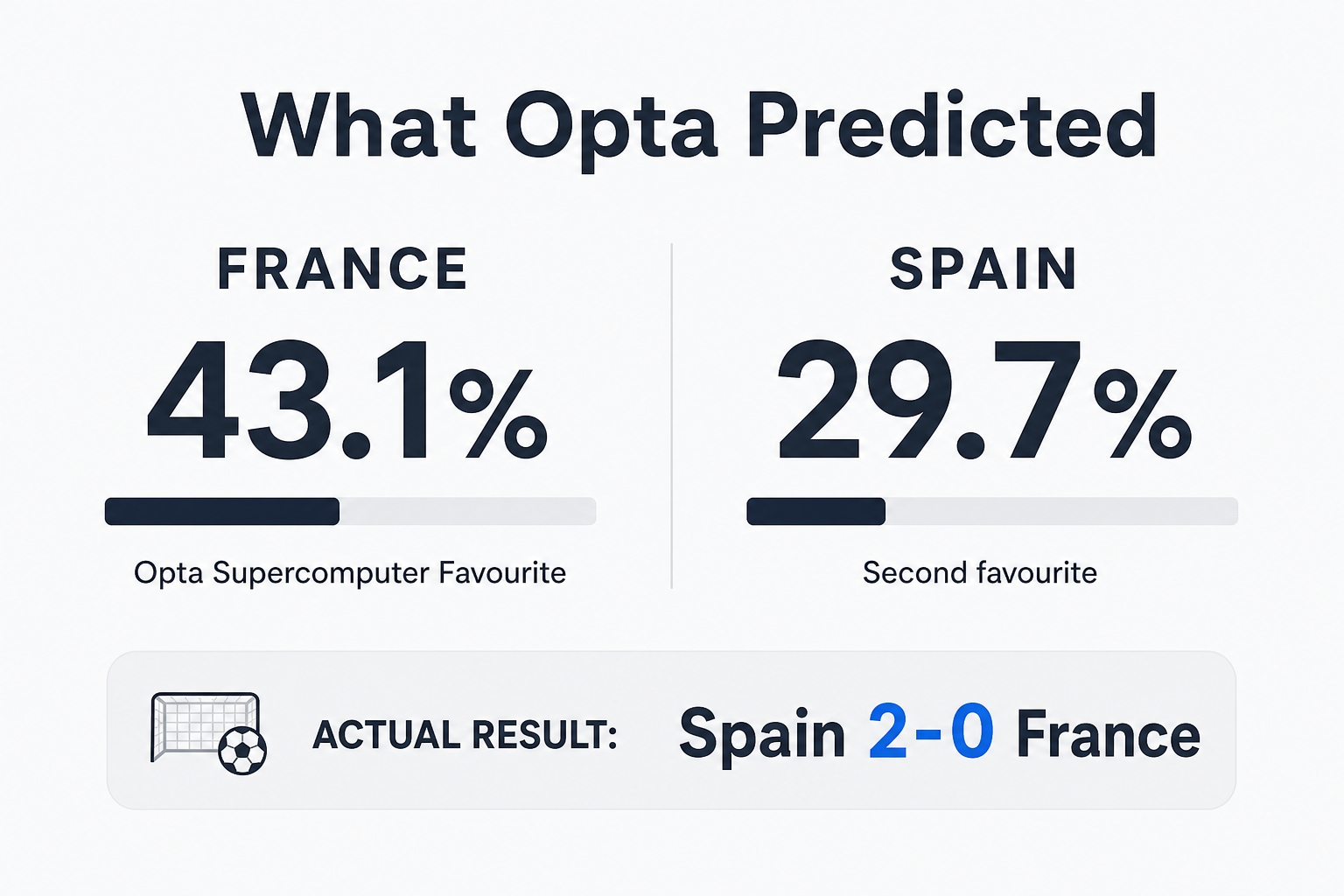
Before a ball was kicked at AT&T Stadium on July 14, The Analyst – Opta’s publishing arm – ran its standard 25,000-simulation pass through the match and landed here:
- France: 43.1% chance of winning in 90 minutes
- Spain: 29.7% chance of winning in 90 minutes
- Extra time: 27.2%
And if you zoomed out to the full tournament picture at the semi-final stage, France were given 33.6% to win the World Cup outright. Spain, despite being pre-tournament favourites at 16.1%, had settled in at 23.4% – second favourites by this point.
The logic behind favouring France was solid. France had scored 16 goals in 6 games heading into the semi-final. They had generated 14.3 total xG across the tournament – the highest of any remaining team. Mbappé had 8 goals. Michael Olise had 5 assists in a single World Cup, the first player to do so since 1994. On paper, France’s attack was historically good.
Spain’s case for the model was built almost entirely on defence. Unai Simón had faced just 7 shots on target in 6 World Cup games – 1.17 per match, the lowest rate recorded since 1966 tracking began. Their xG against was 0.31 per match. Clean sheet after clean sheet. But could that hold against a France attack generating 47 shots on target across the tournament?
That was the question Opta was genuinely uncertain about. 27% for extra time says it all: the model saw this going to 90 minutes without a winner in roughly 1 in 4 simulations. Nobody – no simulation, no pundit, no preview piece on this site – predicted a 2-0 Spain win that made the result look this straightforward.
How the match actually played out
The answer came quickly.
22 minutes. Lucas Digne, tracking a run from Lamine Yamal on Spain’s right, mistimed his challenge inside the penalty area. Ivan Arcides Barton Cisneros pointed to the spot. Mikel Oyarzabal – Spain’s tournament top scorer with 4 goals from the group stage – stepped up and sent Mike Maignan the wrong way. 1-0 Spain.
The goal itself was a data story. Yamal, reportedly not at 100% fitness by multiple accounts and playing his 7th game in 4 weeks, was still the most dangerous creative player on the pitch. The penalty wasn’t created by a moment of genius – it was created by sustained pressure down Spain’s right flank, Digne eventually making a mistake he’d been one step away from making several times already.
Half-time: France 0-1 Spain. Rabiot – who had started the match strongly in midfield – was substituted for Manu Kone at the interval. Deschamps clearly needed fresh legs to press Spain’s build-up play higher. The change did generate more French activity in the second half, but Spain had adjusted too.
58 minutes. Dani Olmo, who had started the game on the bench and came on in the 77th minute – wait, this is the second goal: Olmo fed Porro with a give-and-go pass on Spain’s right, and Pedro Porro finished clinically from 12 yards. The right-back, who had been a constant attacking outlet all tournament, had his moment. 2-0 Spain.
France pushed for a way back. Mbappé was introduced to an attacking role as the game opened up. Mbappé had a chance in the 86th minute – his first real touch in a dangerous position all game – but it came too late and too infrequently to matter.
Final score: Spain 2-0 France. Attendance: 70,176.
The xG gap that tells the real story
This is where Opta didn’t get things wrong so much as the match played out at the extreme end of what was possible within Spain’s defensive range.
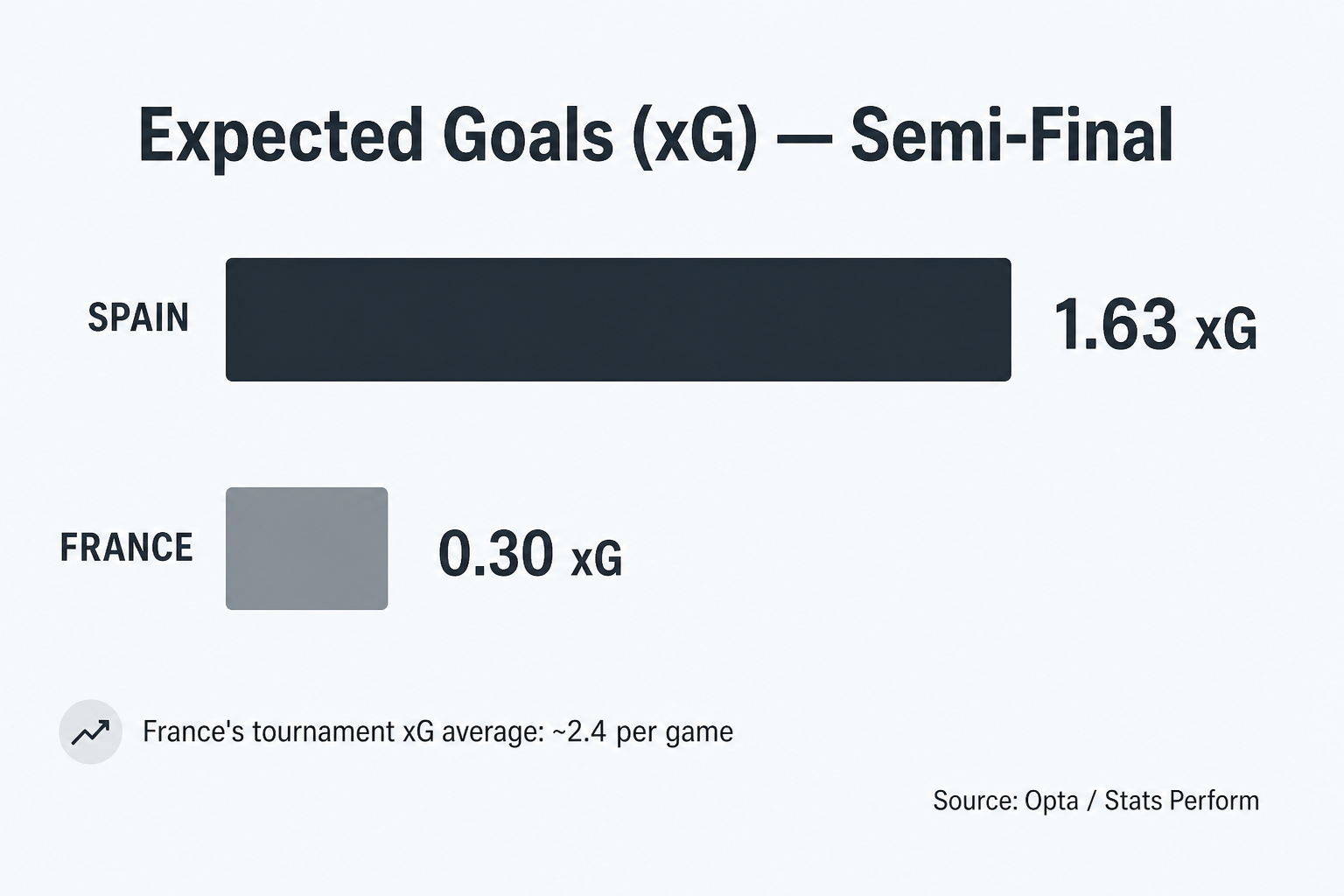
The final xG figures: Spain 1.63, France 0.30.
Put France’s 0.30 xG in context. Across the tournament, France had generated approximately 2.4 expected goals per game. Against Morocco in the quarter-final, a strong defensive side, France still created well over 1.0 xG. Against Spain, they created barely a quarter of that.
Both teams took 10 shots. France had 3 on target to Spain’s 2. Spain created 2 big chances; France created 0. That’s the crux of it. France could get the ball into dangerous-looking areas, but Spain’s defensive positioning – particularly Cucurella tracking Mbappé and the central duo of Cubarsi and Laporte reading Olise and Doué’s runs – turned almost every France attack into a low-quality shot from distance or a blocked cross.
For a team with the xG-generating ability France had shown all tournament, 0.30 isn’t just poor – it’s historically poor. Opta’s own tournament numbers had Spain holding opponents to 0.31 xG per game. France came in fractionally lower. But for an attack as good as France’s, hitting exactly the bottom of that range when it mattered most tells you something about how well Spain’s game plan was executed.
“Spain haven’t conceded in seven games. The way they defended today – especially against Mbappé – was the best defensive performance I’ve seen at this World Cup.” – The Analyst, post-match tactical summary, July 14, 2026
Why Opta wasn’t wrong, exactly
There’s a temptation after results like this to declare the model broken. France 43.1% favourite, France loses 0-2 – wasn’t Opta wrong?
No. And it’s worth understanding why, especially if you use Opta data to inform betting or analysis.
A 43.1% win probability for France means France would win this specific match – played 10 times under identical conditions – roughly 4 or 5 times. Spain would win roughly 3 times. Extra time the other 2 or 3. A 2-0 Spain win is entirely within the range of outcomes that probability distribution describes. The model wasn’t saying France would win. It was saying France should win more often than not if this match were played repeatedly.
The better question to ask is: did the model correctly weight the factors? And here, there’s a genuine critique. Opta’s pre-tournament figures weighted France’s attacking output heavily – 16 goals, 47 shots on target, Mbappé’s historic form – but may have underweighted one specific dynamic: what happens when you put the tournament’s best attack against the tournament’s best defense in a match where Spain had the tactical preparation time and motivation to build a specific anti-France game plan?
Opta’s model is based on historical team strength and recent performance. It’s less able to capture the impact of a single match-specific tactical plan. Spain’s setup on July 14 wasn’t “defend well generally” – it was a precise, detailed plan to funnel France into the exact areas where Laporte and Cubarsi could win aerial duels and Rodri could mop up second balls. France’s 0.30 xG reflects how well that plan worked.
The model was right to flag this as a coin-flip match. The coin just landed on Spain’s side – emphatically.
Spain’s defensive record: the historic backdrop
You can’t fully appreciate Spain’s semi-final performance without stepping back and looking at the record they’ve built across the tournament.
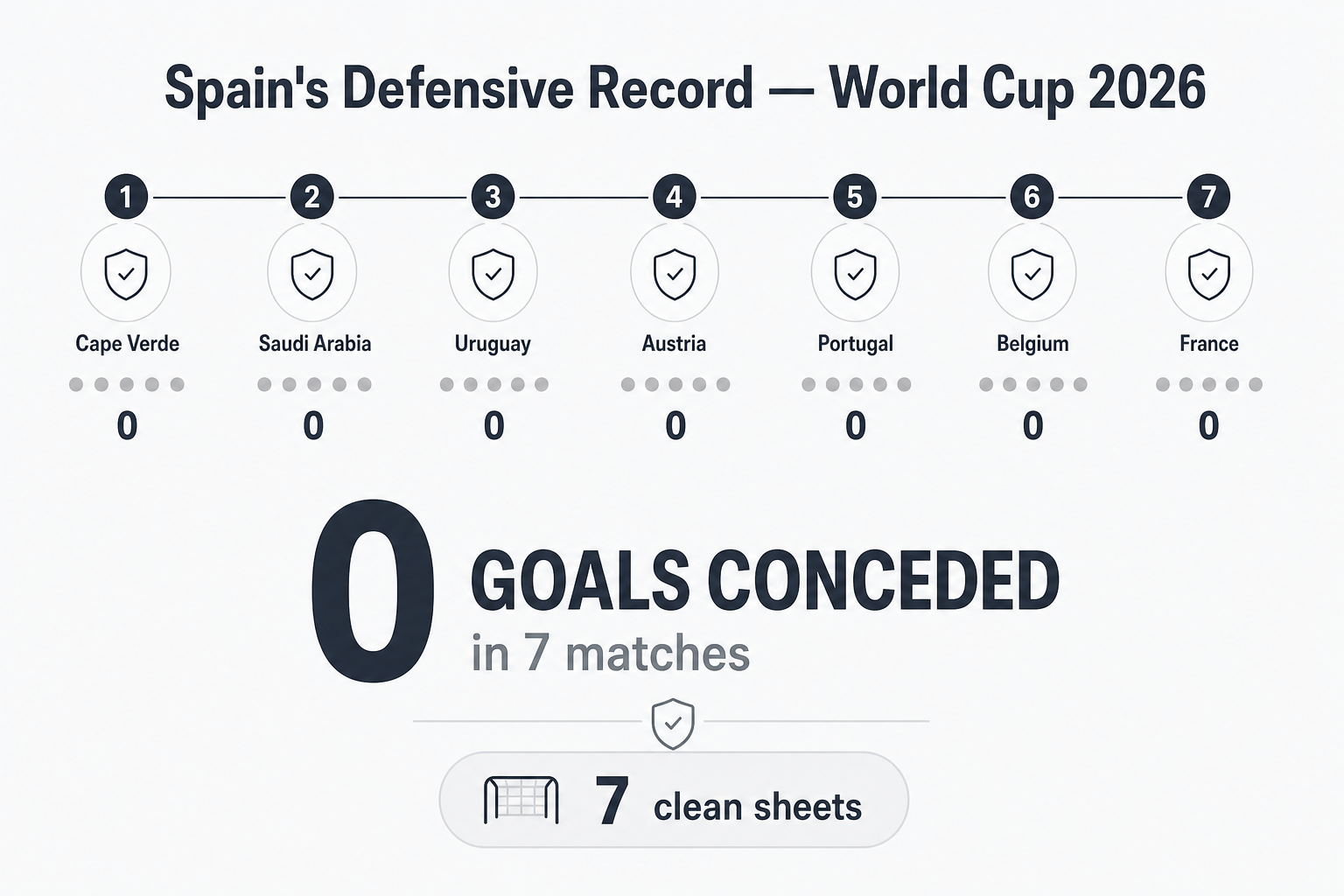
Seven games. Zero goals conceded. Unai Simón’s shutout run had become the longest in modern World Cup history by the time the semi-final kicked off. And then they kept France – the tournament’s most dangerous attack – to 0.30 xG.
Here’s how that compares:
| Opponent | Goals conceded | Shots on target faced |
|---|---|---|
| Cape Verde | 0 | 1 |
| Saudi Arabia | 0 | 2 |
| Uruguay | 0 | 1 |
| Austria | 0 | 0 |
| Portugal | 0 | 1 |
| Belgium | 0 | 1 |
| France | 0 | 3 |
France’s 3 shots on target was the most Spain had faced all tournament. Which, given that France had Mbappé in the form of his life, is either a tribute to Simón or – more accurately – a tribute to the defensive structure in front of him that never let France create clean opportunities in the first place.
The match’s key tactical story: how Spain stopped Mbappé
Kylian Mbappé finished the tournament with 8 goals across 7 games. He had 0 shots on target in the semi-final.
Luis de la Fuente’s answer to Mbappé was not a man-marker. It was a system. Spain’s left side – Marc Cucurella at left-back and Gavi in left midfield – doubled up on Mbappé every time France tried to build through their captain. Crucially, Rodri and Fabian Ruiz screened central lanes, which meant Mbappé’s typical run-in-behind option was consistently cut off.
France’s best route against Spain was usually the wide overload – Mbappé receiving out wide, isolating a full-back one-on-one. That’s how he scored so freely earlier in the tournament. Against Cucurella – who has made a career of defending athletic wide forwards – those one-on-ones produced nothing.
By the time Mbappé had a meaningful touch in the final third (the 86th minute), the game was gone. His substitution at that point came too late to change anything.
The possession numbers tell a similar story. Final split: Spain 51%, France 49%. Nearly even. Which means France had the ball – they just couldn’t do anything dangerous with it when Spain’s defensive shape contracted in the final third. Pass accuracy was Spain 86%, France 84%. Duels won: Spain 52, France 41. Spain controlled the physical battle.
Player ratings from a Spain perspective
Mikel Oyarzabal – 8/10. The goal was taken well, but the bigger contribution was his pressing game – consistently making the first press on France’s centre-backs to trigger Spain’s defensive shape. Five goals at the tournament now.
Lamine Yamal – 9/10. Won the penalty. Drew fouls across the pitch. Created the one moment of genuine panic in France’s defensive block (a dribble in the 34th minute that Saliba just about resolved). Still reportedly not fully fit. Still the best creative player in the tournament.
Rodri – 8/10. 18 tackles and 32 possessions won in the tournament coming in. Added to both tallies here. The anchoring presence that let Gavi and Pedri push higher with confidence.
Pedro Porro – 8/10. Goal, constant forward running, and – critically – tracked back every time France tried to exploit the space behind him. A complete performance from a right-back who has quietly been one of Spain’s most consistent players across 7 games.
William Saliba (for France) – 7/10. Played well in a game where he wasn’t tested particularly hard. The problem for France wasn’t Saliba; it was that France never got the ball into areas where Saliba’s composure on the ball was relevant.
Was Opta wrong? The honest verdict
Opta wasn’t wrong. France were the correct statistical favourite going in, and the model said so with appropriate uncertainty – 43.1% is a slight lean, not a guarantee.
What the data didn’t – and couldn’t – fully capture was the match-specific tactical factor. Spain came into this semi-final with a precise game plan: deny Mbappé the one-on-ones he thrives in, force France wide into Cucurella’s range, and build from the back with Yamal creating the danger from Spain’s right. It worked almost perfectly.
The xG of 0.30 for France is the real story here. That’s not bad luck – that’s a game plan executed to near-perfection.
If you’re using Opta probabilities to inform analysis or betting, the lesson isn’t “ignore Opta.” It’s “understand what the model can and can’t price.” Opta prices historical strength and recent form well. It cannot price the single tactical game plan one specific team has built for one specific match. When Spain played their perfect defensive version on July 14, the model’s 29.7% chance became the reality.
Spain go to the World Cup Final. They haven’t conceded a goal in 7 games. If history doesn’t already feel like it’s being made, it should.
Faston.click
Faston.click is your destination for fast, data-driven football coverage throughout the 2026 World Cup. From Opta prediction guides to live match breakdowns and player analysis, we cover every angle of the tournament with the stats to back it up. Follow along for semi-final and final coverage as Spain push for football history.
Frequently Asked Questions
What was the result of Spain vs France in the 2026 World Cup semi-final?
Spain defeated France 2-0 in the semi-final at AT&T Stadium (Dallas) on July 14, 2026. The goals came from Mikel Oyarzabal via penalty in the 22nd minute and Pedro Porro in the 58th minute.
What did Opta predict for the France vs Spain semi-final?
Opta’s Supercomputer, published via The Analyst, gave France a 43.1% chance of winning in normal time, Spain 29.7%, and a draw leading to extra time 27.2%. France were the model’s favourites going in.
What were the expected goals (xG) in Spain vs France at World Cup 2026?
Spain’s xG was 1.63 and France’s was just 0.30, according to Opta / Stats Perform data. France had averaged approximately 2.4 xG per game across the tournament – their 0.30 in Dallas was a historic underperformance driven entirely by Spain’s defensive structure.
Who scored for Spain against France in the World Cup 2026 semi-final?
Mikel Oyarzabal opened the scoring from the penalty spot in the 22nd minute, after Lucas Digne fouled Lamine Yamal inside the box. Pedro Porro added Spain’s second in the 58th minute with a finish from a move involving Dani Olmo.
Was Opta wrong about France vs Spain?
Not exactly. Opta gave probabilities, not guarantees – and a 43.1% win chance for France is not a prediction, it’s an estimate. What surprised the data was the extreme margin: France’s attack, which had generated 16 goals and 14.3 xG across the tournament, was held to just 0.30 xG. Spain’s defense performed at the top end of even its own historic range.