
FIFA World Cup 2026 prize money, revenue, and financial details: the complete breakdown
The 2026 Fifa World Cup is football’s biggest financial event ever – $871M in prizes, $8.9B for FIFA, and a very different deal for host cities. Here’s where every dollar goes.
July 12, 2026 · 16 min read
TL;DR
The 2026 FIFA World Cup is the most financially ambitious sporting event in history. FIFA is on track to collect $8.9 billion while distributing $871 million in prize money. The winner takes $50 million (up from $42M in 2022), group-stage exits get $9 million, and every team is guaranteed at least $12.5 million before a ball is kicked. Players see a fraction of those figures after their federation takes its cut. And the host cities – USA, Mexico, Canada – are covering billions in costs while FIFA captures almost all the revenue. Here’s how every dollar moves.
The numbers that make this World Cup historic
Before breaking down where the money goes, the scale deserves a moment. FIFA’s 2026 prize pool of $871 million is nearly double what was distributed in Qatar 2022 ($440 million). FIFA itself projects total tournament revenue of $8.9 billion – and some analysts think that’s conservative. Richard Sheehan, professor emeritus of finance at Notre Dame, estimates soaring ticket prices could push FIFA’s total 2023–2026 cycle income past $15 billion.
Three things drove the explosion:
- 48 teams instead of 32 – 104 matches instead of 64, more broadcast inventory, more sponsorship opportunities, more tickets sold
- Dynamic pricing – the first World Cup to let ticket prices float with demand, the way airline seats do; face values range from $60 to $7,875 for a Category 1 final seat, and resale prices have gone far higher
- North American commercial market – US broadcast rights alone are up 94% from 2022; advertising spend from Fox and Telemundo combined is projected at $850 million
Prize money breakdown: every round, every dollar
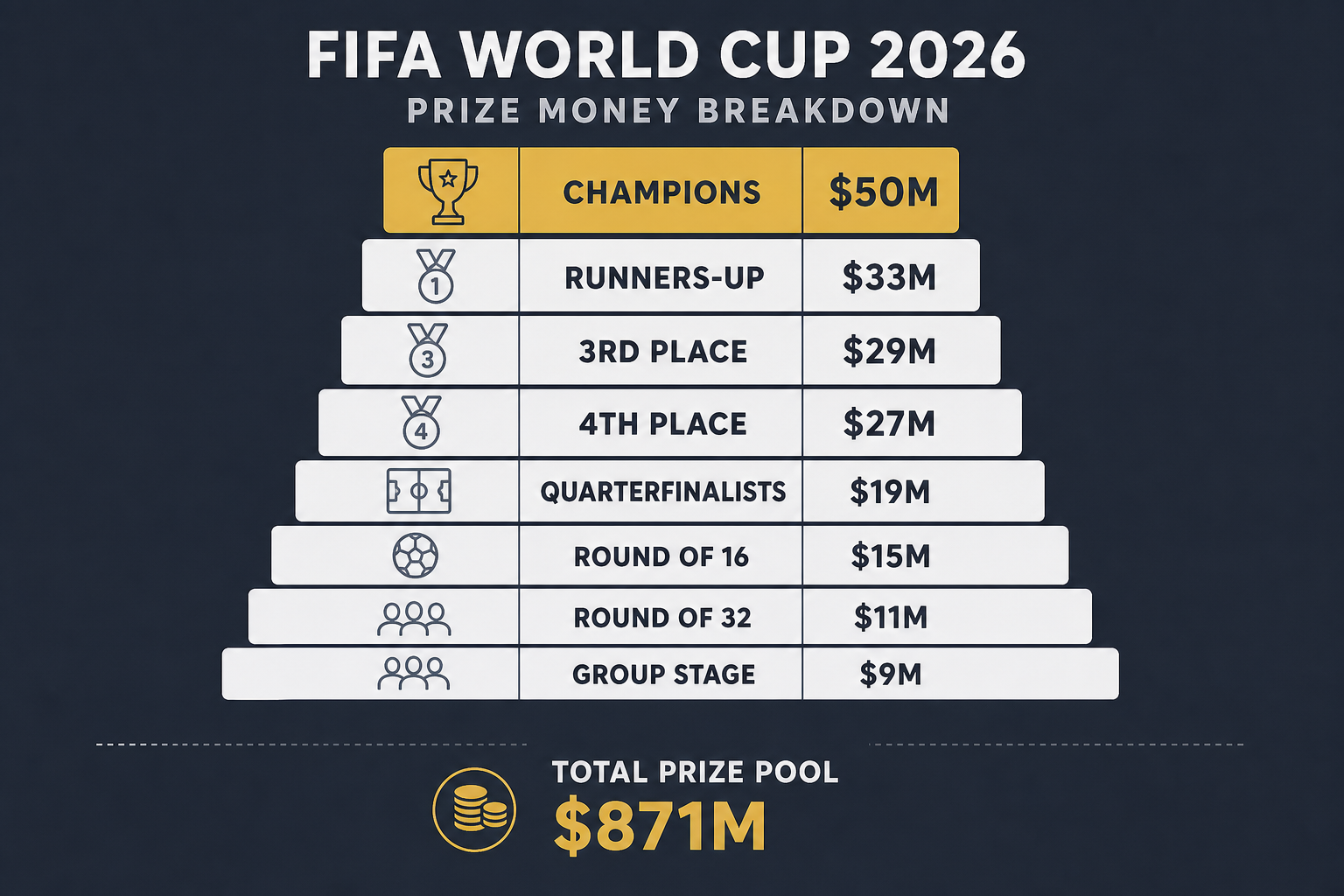
FIFA splits the $871 million prize pool into two buckets: performance-based prizes ($703 million) and guaranteed financial support for every nation ($168 million).
Performance prizes by round
| Round | Teams | Prize per team |
|---|---|---|
| Champions | 1 | $50,000,000 |
| Runners-up | 1 | $33,000,000 |
| Third place | 1 | $29,000,000 |
| Fourth place | 1 | $27,000,000 |
| Quarterfinals | 4 | $19,000,000 each |
| Round of 16 | 8 | $15,000,000 each |
| Round of 32 | 16 | $11,000,000 each |
| Group stage exit | 16 | $9,000,000 each |
The guaranteed floor
Every one of the 48 qualified nations receives guaranteed funding regardless of results:
- Qualification funding: $10 million per team
- Preparation funding: $2.5 million per team (training camps, travel, squad logistics)
- Additional team contributions: $16+ million distributed across all participants for travel and ticketing allocations
The minimum any team earns – a group-stage exit after three losses – is $9M in performance prize + $12.5M guaranteed = $21.5 million total. That’s still more than the group-stage prize alone at the 2018 Russia World Cup.
How the champion compares to history
Argentina won Qatar 2022 with a $42 million prize. The 2026 champion will walk away with $50 million in performance prize money alone – plus the $12.5M guaranteed floor and additional team contributions, pushing the total beyond $63.5 million. That’s a 51% jump in the champion’s take in just four years.
FIFA’s revenue machine: where $8.9 billion comes from
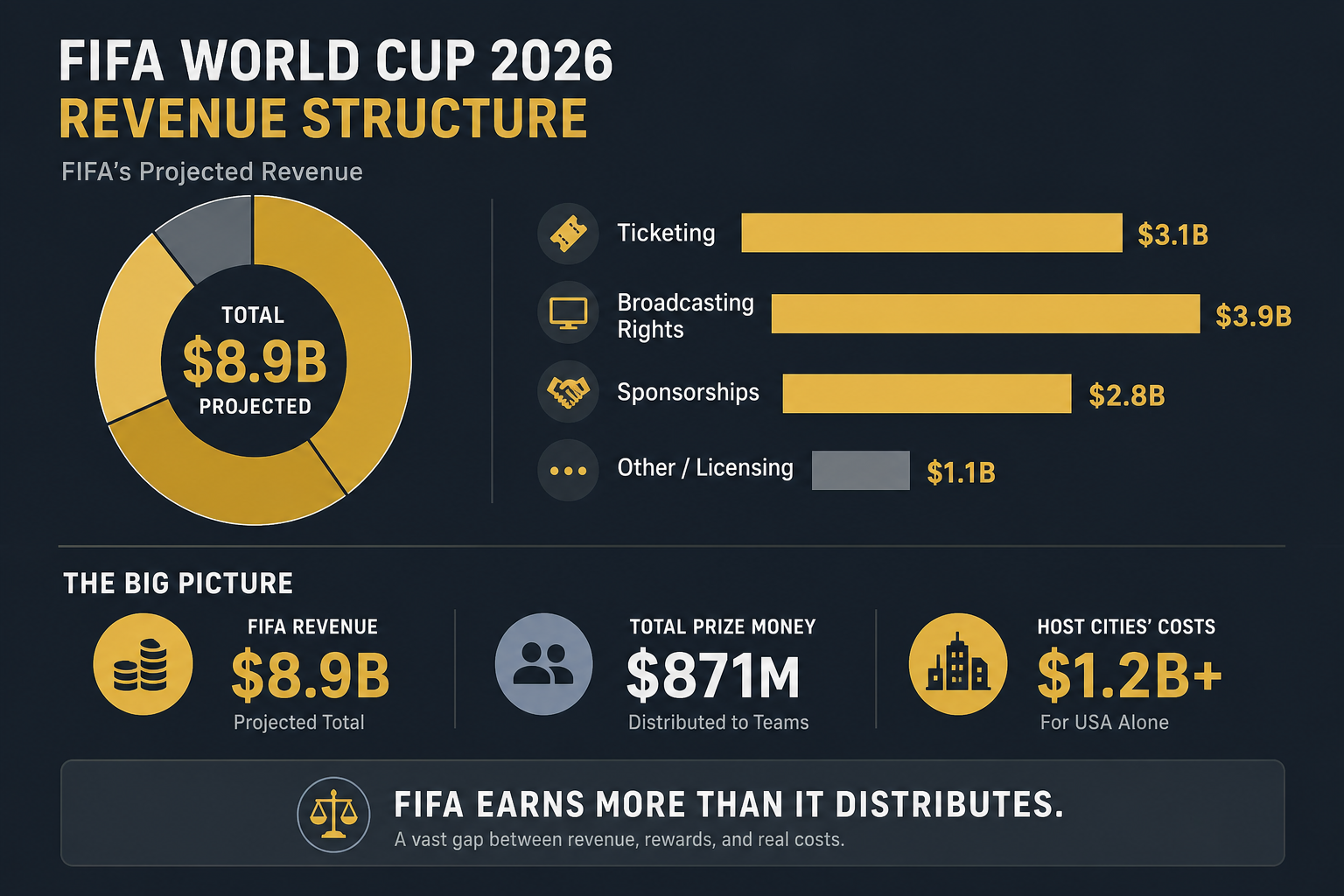
According to SportsPro’s analysis of FIFA’s commercial structure, the $8.9 billion breaks down roughly as follows:
| Revenue stream | Amount |
|---|---|
| Broadcasting rights | ~$3.9 billion |
| Ticket sales and hospitality | ~$3.1 billion |
| Sponsorship | ~$2.8 billion |
| Licensing and other | remainder |
To put these numbers in context: FIFA reported generating roughly $14 billion across the two World Cup cycles from 2015 to 2022 (Russia 2018 + Qatar 2022 combined). The 2026 tournament alone is on track to match or exceed that.
Broadcasting rights: the biggest slice
The $3.9 billion in broadcast rights marks a 22% increase from Qatar 2022 – and the US growth is even more striking. Broadcast rights value in the United States alone increased by 94% from 2022. The rights landscape in key markets:
- USA: Fox (70 of 104 matches), Telemundo (Spanish language), with Fox One DTC and Tubi streaming additional coverage
- UK: BBC and ITV (free-to-air)
- Brazil: CazéTV, streaming all matches on YouTube
- Germany: Deutsche Telekom, ARD, ZDF, DAZN
- Japan, Italy, Spain: DAZN, plus local public broadcasters
A Bank of America report estimates around six billion people – 75% of the world’s population – will watch some part of the tournament via TV, streaming, or social media. That audience is what broadcasters paid $3.9 billion for the right to reach.
Ticketing: the dynamic-pricing experiment
Ticket sales are projected to generate $3.1 billion – more than triple the $930 million from Qatar 2022. The driver is a mechanism FIFA deployed at a World Cup for the first time: dynamic pricing, where face values float with demand.
As sports economist Victor Matheson at College of the Holy Cross explained to Fortune: “FIFA is not coming back to the United States for another 30 or 40 years. Which means that you can afford to make that ticket buyer angry today, and squeeze all of the money out of them you can.”
The result? The most expensive World Cup in history. A Category 1 final seat has a face value of $7,875. On the official resale platform (where FIFA collects a 15% commission from both buyer and seller), at least one listing reportedly offered a final ticket for $11.5 million. Even Trump, FIFA president Gianni Infantino’s close ally, said he wouldn’t pay $1,000 for a match ticket.
FIFA received over 500 million ticket requests across the tournament.
Sponsorship: the $2.8 billion brand alliance
Sponsorship revenue reached a record $2.8 billion – up 37% from Qatar 2022’s $1.87 billion. FIFA’s top-tier global partners, who sponsor all FIFA events and locked in long-term deals, include:
| Partner | Category | Deal runs through |
|---|---|---|
| Adidas | Official Kit & Technical Partner | 2030 |
| Coca-Cola | Global Beverage Partner | 2030 |
| Aramco | Global Energy Partner | 2027 |
| Hyundai-Kia | Official Mobility Partner | 2030 |
| Lenovo | Official Technology Partner | 2027 |
| Qatar Airways | Official Airline Partner | 2030 |
| Visa | Official Payment Technology | 2026 |
Tournament-specific sponsors include Verizon, Lay’s, Bank of America, and Unilever. Several new partners stepped in to replace Byju’s, Crypto.com, and Vivo, who dropped out after Qatar. FIFA’s commercial team reportedly sold out nearly the entire sponsorship inventory.
From FIFA to your favorite player: how the money actually flows
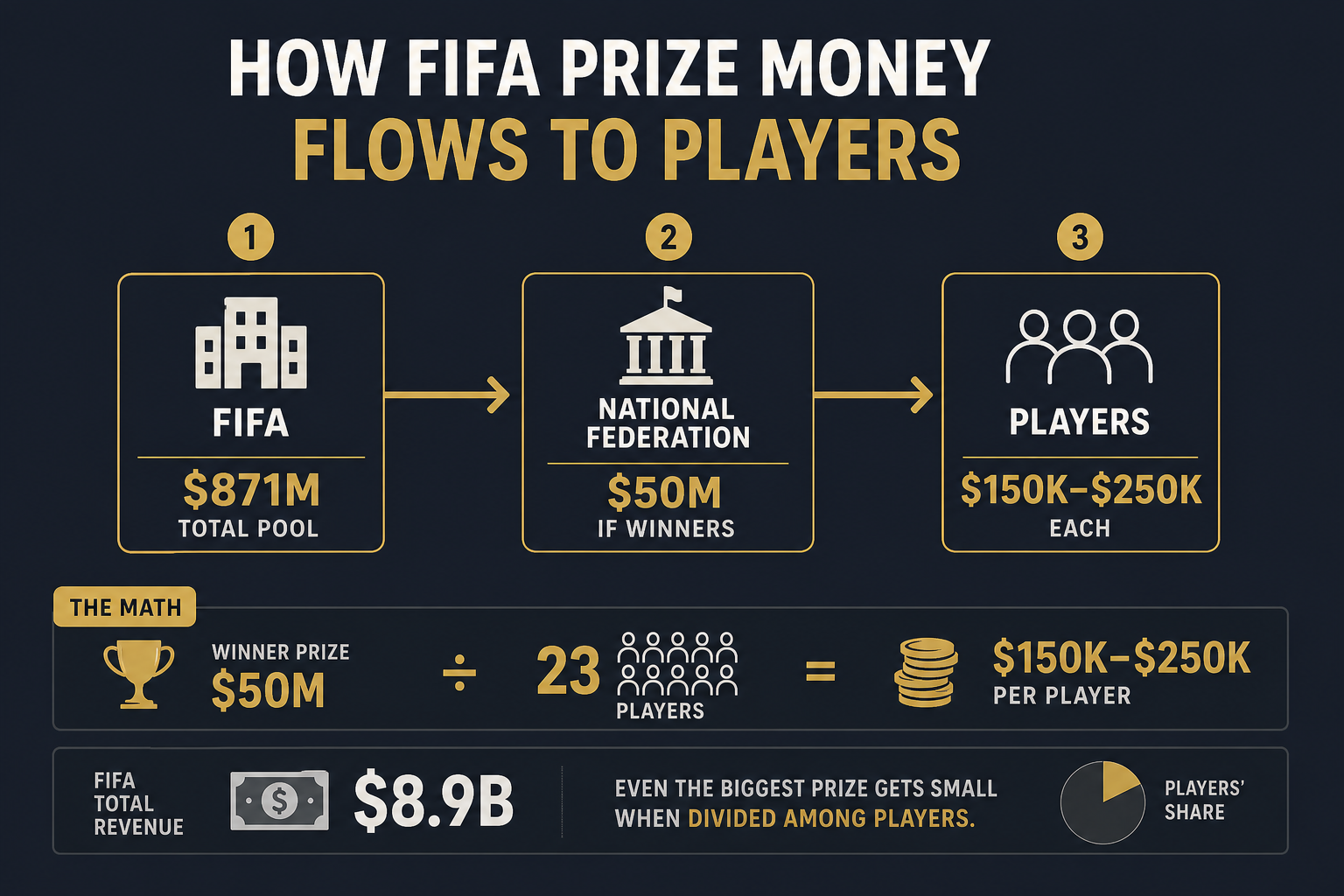
Here’s the thing most fans don’t realize: no player ever sees a FIFA cheque directly. The money flows through a chain – and it shrinks at every step.
The chain looks like this:
- FIFA collects $8.9B in revenue
- FIFA distributes $871M in prize money to national federations
- National federations distribute player bonuses according to their own structures (collective bargaining agreements, player council decisions, or in some cases, the federation’s discretion)
- Players receive a share – typically ranging from $5,000 to $250,000+ depending on the federation and tournament stage reached
The federation keeps the rest for operational costs, women’s programs, youth development, and future investment.
What winning players actually earn
Take a French player on a World Cup-winning squad. FIFA hands the French federation $50 million. If France distributes $150,000–$250,000 to each of its 23 squad members, the total payout to players is $3.5–5.7 million – leaving more than $44 million with the federation.
Known player bonus structures for 2026 based on federation agreements:
| Federation | Winner bonus per player | Runner-up | Semifinal exit |
|---|---|---|---|
| England | ~$400,000–$500,000 | ~$200,000–$250,000 | ~$100,000 |
| Germany | ~$300,000 | ~$150,000 | ~$75,000 |
| Spain | ~$100,000+ | ~$50,000+ | ~$20,000+ |
| Argentina | $150,000–$200,000+ | n/a | $50,000+ |
| Mexico | ~$75,000 | n/a | ~$15,000 |
| Japan | ~$50,000 | n/a | ~$20,000 |
For a player on a squad eliminated in the group stage from an African or Asian federation, the direct bonus can be as low as $5,000–$15,000 – meaningful relative to local salaries, but a fraction of what the federation received. Cameroon, for example, would receive ~$21.5 million total but might distribute $5,000–$15,000 per player.
Club compensation: another layer
FIFA also compensates clubs for releasing players. The club benefit program pays approximately $15,000–$50,000 per player for the tournament window (around 28–30 days for groups-through-final runs, pro-rated for earlier exits). European clubs receive higher amounts than non-European clubs. If a player is injured during the tournament, clubs can claim additional compensation, estimated at $25,000–$100,000+ depending on player market value.
USA, Mexico, and Canada: the billion-dollar gamble
The 2026 World Cup introduced something new in how FIFA relates to host nations. For the first time in history, FIFA is running the tournament directly rather than through a local organizing committee. The consequence is structural: FIFA controls all the revenue, and host cities cover all the costs.
As economist Andrew Zimbalist of Smith College put it: “There are very, very significant costs to host cities, which host anywhere from four to eight games. I think it’s fair to say that none of them will benefit economically from the World Cup because they don’t get the revenue, but they get the costs, which can run well over $100 million.”
What the USA spent
The US federal government committed approximately $1.2 billion:
- $600M+ on security across 11 host cities
- $500M on drone-attack prevention
- $100M on transportation improvements
Each US host city faces an additional $100–$200 million or more in local costs – traffic management, NYPD deployment, emergency services, fan zones, venue preparation.
The 11 US cities face a collective shortfall of up to $250 million, according to The Independent. FIFA’s commercial exclusivity rules locked host cities out of signing local sponsors in most categories – Verizon, McDonald’s, Bank of America, and others were already spoken for as FIFA global partners, leaving cities unable to recoup costs through their own corporate neighbors.
New York’s math doesn’t add up
New York/New Jersey is hosting the final at MetLife Stadium – the biggest prize in host-city bragging rights. But New York City Comptroller Mark Levine ran the numbers and they don’t work. Even if FIFA’s projection of 1.2 million regional visitors fully materializes, the city estimated an additional tax revenue of no more than $55 million – while spending roughly $70 million in added NYPD, emergency management, and small-business support costs.
That’s a net loss in the optimistic scenario. NJ Transit’s bill for moving fans to MetLife is $62 million, covered only $14 million by outside grants. The transit authority initially set a $150 round-trip fare from Manhattan (a 20-minute ride that normally costs $13), then cut it twice to $98 – subsidized not by FIFA, but by DoorDash, FanDuel, and American Water.
“When I spend $400 on a World Cup ticket, that money all goes to FIFA. So not only is it not going to any local person in the first place, they’re not taking that money and then respending it in the local economy either.” – Victor Matheson, economist, College of the Holy Cross
Mexico and Canada
Mexico’s three host cities (Mexico City, Guadalajara, Monterrey) relied on existing world-class stadiums – Estadio Azteca, Estadio Akron, and Estadio BBVA – requiring limited upgrades. As a smaller host (fewer matches than the USA), Mexico’s exposure is proportionally lower, but so is its revenue.
Canada’s Parliamentary Budget Officer estimated federal spending at approximately $82 million per game across 13 games – roughly $1.07 billion total for Vancouver and Toronto. Canada gets considerably less upside in return: fewer matches than the US, a smaller English-language sports broadcast market, and the same FIFA revenue structure.
What the host countries receive
FIFA projected the tournament will generate $40.9 billion in global GDP impact, with $17.2 billion going to the US. Independent economists are more skeptical. Goldman Sachs analyst Kevin Daly estimated the impact at just 0.2% of US GDP. Saxo Bank concluded the World Cup is “not a meaningful growth driver for the United States.”
On the ground, early data is more encouraging: in-person credit and debit card spending in the 16 host cities was up 6.3% year-over-year during the group stage, driven by a 16.7% increase from non-local spenders, according to Forbes.
Where past World Cups hurt hosts most was in stadium construction: Brazil spent $12 billion for 2014, Russia $14 billion for 2018, and Qatar an estimated $220 billion for 2022. The 2026 edition avoided that by using existing NFL and MLS stadiums. That makes it, in the words of Andrew Giuliani of the White House World Cup Task Force, “more efficient than maybe anybody before.”
“Our stadiums are much larger than in the rest of the world,” said Matheson, “so the number of fans who can attend is greater. And our host cities are big metropolitan areas that can accommodate a larger number of fans. So, with higher profits and lower costs than in recent World Cups, it’s much more likely that this edition will have a net positive impact for the hosts.”
The caveat: net positive for the overall North American economy is not the same as net positive for each individual host city – and FIFA’s model means cities bear costs while multinationals capture the upside.
The economics of who really wins
A University of Toronto analysis found that 12 of the last 14 World Cups produced net economic losses for their host regions. The reasons economists cite are consistent across tournaments:
Substitution effect: fans spending $400 on a World Cup ticket spend $400 less on something else locally. No new economic activity is created.
Crowding out: World Cup tourism often displaces regular tourists. Hotels fill with football fans, but the Louvre, the local restaurants, the weekend getaway travelers – they go elsewhere. Paris saw attendance at the Louvre drop 25% during the 2024 Olympics while hotels were full.
Leakage: ticket revenue leaves the local economy entirely – it goes to FIFA’s Swiss bank accounts. Hotel surcharges flow to corporate headquarters, not to front desk workers.
NC State professor Michael Edwards captures the honest conclusion: “The honest conclusion may be that the World Cup was a valuable shared experience without being a successful economic-development strategy.”
The real winner, consistently, is FIFA. Its $8.9 billion in revenue dwarfs the $871 million prize pool it distributes, the $1.2 billion the US spent on security and transport, and the collective shortfall facing host cities. Gianni Infantino campaigned for the FIFA presidency in 2016 promising to quadruple the organization’s income. After 2026, he’ll have delivered.
The fan access paradox
There’s a painful irony in the financial structure: the world’s most-watched sporting event is becoming increasingly inaccessible to the fans of the sport. Ticket prices have made 2026 the most expensive World Cup in history – with final tickets starting at $10,000 on the official platform, roughly ten times the cost at Qatar 2022.
80% of hotels in US host cities reported below-forecast bookings, with 65–70% citing visa concerns and geopolitical tensions. Foreign visitors are the primary engine of host-country economic benefit – a local fan buying a ticket just moves money around the same economy. Fewer international arrivals means a weaker economic case for cities and a quieter-than-expected tournament for neighborhoods that bet on it.
Try faston.click
faston.click is your home for fast, accurate sports coverage – from live scores and match statistics to tournament standings and deep-dive analysis like this. Follow along with every match, player statistic, and bracket update from the 2026 World Cup, updated in real time as the tournament moves from quarterfinals to the final at MetLife Stadium on July 19.

Frequently Asked Questions
How much prize money does the FIFA World Cup 2026 winner receive?
The winner of the FIFA World Cup 2026 receives $50 million in performance-based prize money. When combined with guaranteed qualification and preparation funding of $12.5 million, the champion’s total compensation exceeds $63.5 million – the largest payout in World Cup history, up 51% from Argentina’s $42 million in 2022.
What is the total prize pool for the FIFA World Cup 2026?
FIFA has set a record-breaking total prize pool of $871 million for the 2026 World Cup – a 97.5% increase from the $440 million distributed at Qatar 2022. The pool covers all 48 participating teams, with payouts ranging from $9 million for group-stage exits to $50 million for the champions.
How much does FIFA earn from the 2026 World Cup?
FIFA projects total revenue of approximately $8.9 billion from the 2026 World Cup, contributing to a $13 billion target for the full 2023–2026 cycle. Revenue comes from broadcasting rights ($3.9B), sponsorships ($2.8B), ticket sales ($3.1B), and licensing and hospitality deals.
How much do players actually earn from World Cup prize money?
Players don’t receive FIFA prize money directly – it goes to their national federation first. Federations then distribute bonuses according to their own structures. Winning players typically receive $150,000–$250,000 each (for elite European federations like France or England), while players from less wealthy nations can receive as little as $5,000–$15,000 even when their team qualifies and participates.
Do host cities make money from the FIFA World Cup?
The evidence is mixed, and independent economists are skeptical. Under the 2026 model, FIFA controls all major revenue streams (tickets, media rights, sponsorship) while host cities cover security, transport, and infrastructure costs of $100–$200M or more each. New York City’s own Comptroller estimated the city would spend $70M in extra costs while generating only $55M in additional tax revenue. A University of Toronto study found 12 of the last 14 World Cups produced net economic losses for host regions.