FIFA World Cup 2026: Top Scorers, Best Matches & Biggest Surprises So Far
World Cup 2026 is underway with Messi leading the Golden Boot race, Portugal vs Colombia shaping as the best match, and dark horses like Norway shocking everyone.
June 23, 2026 · 12 min read
TL;DR
We’re roughly two weeks into the 2026 FIFA World Cup, and it’s already delivering drama. Lionel Messi is dominating the Golden Boot race with 5 goals and has become the all-time leading World Cup goalscorer in history. The tournament’s best match is shaping up to be Portugal vs. Colombia on June 27, a clash of technical mastery vs. counterattacking chaos that could decide the group. Dark horse teams like Norway (led by Erling Haaland) are shocking everyone, while the expanded 48-team format is creating more upsets than ever before. Whether you’re tracking the golden boot race or picking your picks for knockout dominance, faston.click keeps you across every goal, every upset, and every must-watch moment.
Introduction
The 2026 FIFA World Cup kicked off on June 11 with a historic change – for the first time ever, the tournament expanded to 48 teams instead of the traditional 32. Hosted jointly across the United States, Canada, and Mexico, this World Cup is already delivering the kind of drama and surprise performances that make the tournament worth losing sleep over.
The expanded format means more teams, more matches, and crucially, more opportunities for Cinderella stories. Where the old 32-team tournament could feel predictable after the first week – the strong teams usually showed their quality, the weaker ones got eliminated – this new format keeps uncertainty alive longer. That’s creating a tournament where upsets aren’t flukes, they’re part of the competitive landscape.
We’re now in the thick of the group stage, and the storylines are starting to crystallize. The golden boot race is tighter than expected, with multiple elite finishers separated by just one goal. The best matches are shaping up to be absolute thrillers – the kind of tactical battles that get replayed for years. And dark horse teams are proving that the expanded format really does create more room for upsets. If you’re a faston.click user tracking live scores, you’ve probably noticed the surge in excitement around these group stage fixtures.
Let’s break down what’s happened so far – the players on fire, the matches that matter most, and the surprises that nobody saw coming.
Top scorers: the golden boot race
The race for the 2026 FIFA World Cup Golden Boot is shaping up to be one of the tournament’s defining stories. With 12+ group stage matches still to play, the competition for the award is genuinely wide open – a fact that rarely happens at World Cups, where top scorers usually separate themselves early.
Leading the charge is Lionel Messi with 5 goals, which puts him in truly historic company – he’s now the all-time leading goalscorer in FIFA men’s World Cup history, surpassing Miroslav Klose’s previous record of 16 goals. His hat-trick against Algeria on June 16 was the moment that cemented his place atop the standings, and it reminded everyone why Messi remains one of the world’s most clinical finishers, even at this stage of his career.
What makes Messi’s record even more remarkable is the era in which he achieved it. Modern tournament football is tighter, more defensive, and more organized than ever before. Scoring five goals in the group stage now is legitimately impressive, especially given the defensive quality of Argentina’s competition. The fact that he’s done it while playing for a team that’s not consistently dominating possession shows his lethal efficiency in the final third – he’s not padding his stats against weaker opposition, he’s converting tight chances against quality opponents.
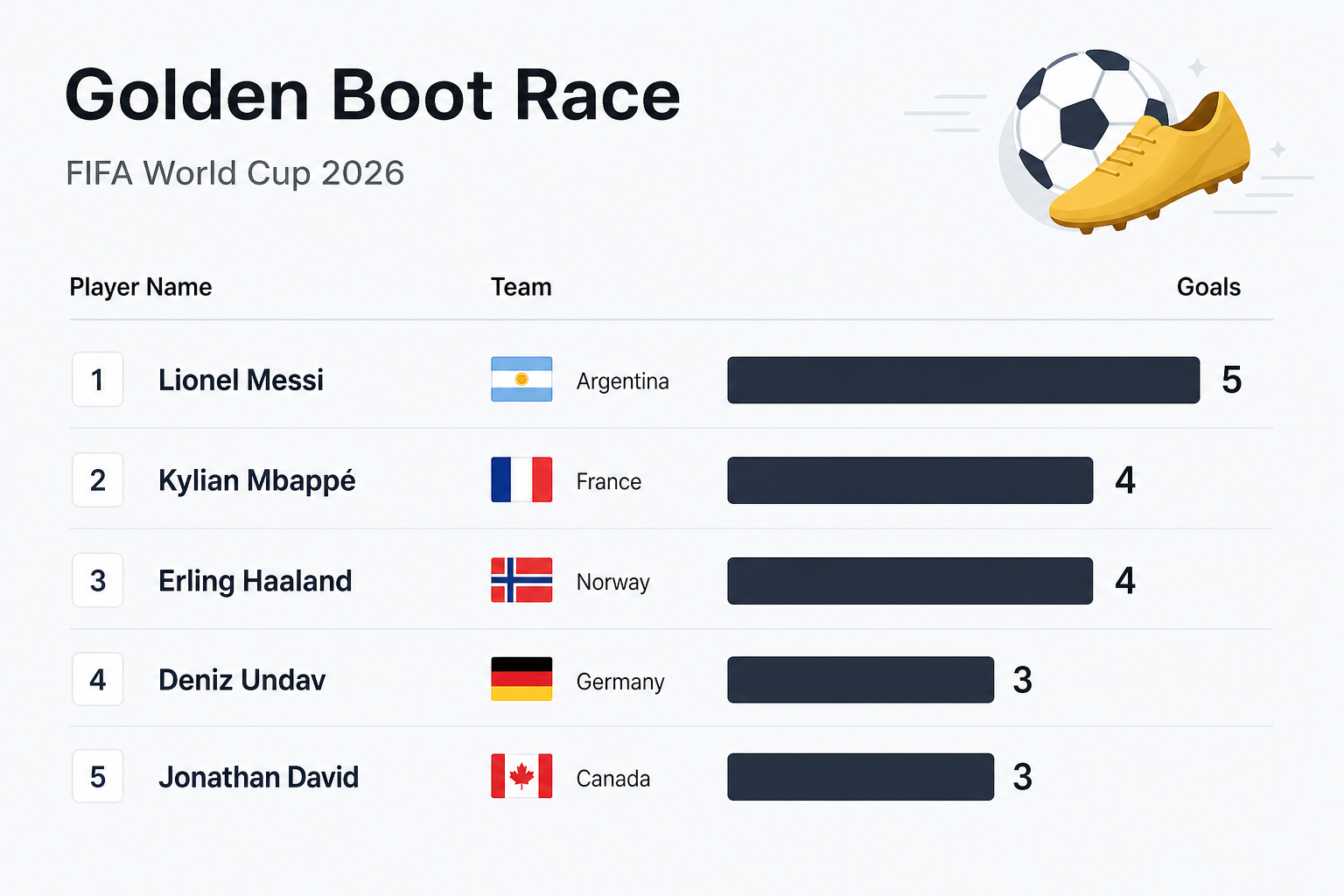
Chasing hard are two other elite finishers. Kylian Mbappé (France) and Erling Haaland (Norway) are both on 4 goals, and the race between them feels genuinely competitive. Mbappé won the Golden Boot at the 2022 World Cup, and he’s attempting to become the first player ever to win the award twice in World Cup history – something that’s never been done. If he pulls it off, it’ll be one of the rarest achievements in international football.
Haaland, meanwhile, is emerging as a genuine surprise at this stage. His pace, finishing instinct, and ability to find space in the box have made him a constant threat. He’s playing for Norway and sitting just one goal behind Mbappé, which makes the race for the Golden Boot one of the most open competitions we’ve seen in recent World Cups.
What’s particularly intriguing about Haaland’s emergence is that Norway came into this tournament without being listed among the favorites. Yet he’s found the net consistently, which speaks to both his personal finishing quality and Norway’s tactical setup that creates space for his runs. If Norway advances from their group, expect Haaland to be a scoring threat all the way through the knockout stages.
Behind the top three, Deniz Undav (Germany) and Jonathan David (Canada) both have 3 goals, keeping the race competitive through the rest of the group stage. This is the kind of balance we rarely see at World Cups – the leading scorer is pulling away, but there’s genuine depth of talent in the goalscoring race.
“Messi’s hat-trick against Algeria was clinical finishing at its finest. Three different moments, three completely different finishes – a penalty, a header, a tap-in. That’s what separates the great finishers.” – Mark Schofield, SB Nation
Best matches so far
Not every World Cup match is worth rewatching. But a handful of group stage fixtures this year are shaping up to be genuinely memorable, and several have already played out with the kind of drama that reminds you why international football captures the world’s attention like nothing else.
England vs. Croatia on June 17 opened the tournament with immediate intrigue. England brings one of the deepest squads in world football, combining attacking talent with tournament experience that comes from their run to the 2020 Euro final. Yet Croatia – as always – played with the kind of composure and technical quality that makes them dangerous in tight matches. The atmosphere in Arlington, Texas was electric, and while the result wasn’t shocking, the match itself delivered the kind of tactical chess that makes you understand why these teams keep reaching major tournament stages. England had to be sharp, alert, and precise – they couldn’t rely on pure quality to carry them, which is exactly when England tends to struggle.
Spain vs. Uruguay on June 26 is one you absolutely need to keep an eye on. This is the kind of match that defines tournament football – a clash between two completely different footballing identities. Spain wants possession, rhythm, and the slow suffocation of positional dominance. Uruguay wants chaos, physicality, and directness. If either team gets control for a stretch, it could turn into an instant classic. The stylistic contrast alone makes this a must-watch.
France vs. Norway on June 26 could be one of the highest-scoring spectacles of the group stage. Both teams are stacked with attacking talent – France’s pace and transition ability against Norway’s lethal finishing (led by Haaland). If this game opens up even slightly, we could see a goal fest that rivals some of the most entertaining World Cup matches in recent memory.
But the standout match? That’s gotta be Portugal vs. Colombia on June 27. Both teams have the talent to make a deep tournament run, and the match offers the best combination of stakes, quality, atmosphere, and stylistic intrigue in the group stage.
This is a proper clash of football philosophies. Portugal’s possession and manipulation of space through Bruno Fernandes and Bernardo Silva creates a methodical, suffocating approach – they want to control the rhythm, dictate the tempo, and wear you down through technical superiority. Colombia’s chaotic, athletic counterattacking through Luis Díaz is the opposite – they want chaos, transition opportunities, and directness. They’ll press aggressively, win the ball back, and hit you on the break with pace and incision.
From a neutral’s perspective, this is the match that could define the knockout bracket before it even begins. Both teams are capable of knocking out anyone they face if they advance as group winners, but finishing position matters hugely for seeding and bracket difficulty. That pressure – combined with the genuine quality on display – makes Portugal vs. Colombia the one World Cup group stage match you absolutely cannot miss.
Biggest surprises and upsets
Part of what makes the expanded 48-team format so compelling is that it genuinely creates more room for surprise results. The old 32-team format would eliminate teams quickly – one or two bad group stage results and you’re done. This new structure gives teams a longer runway to find their rhythm, which means quality teams that stumble early can still claw their way into the knockout rounds.
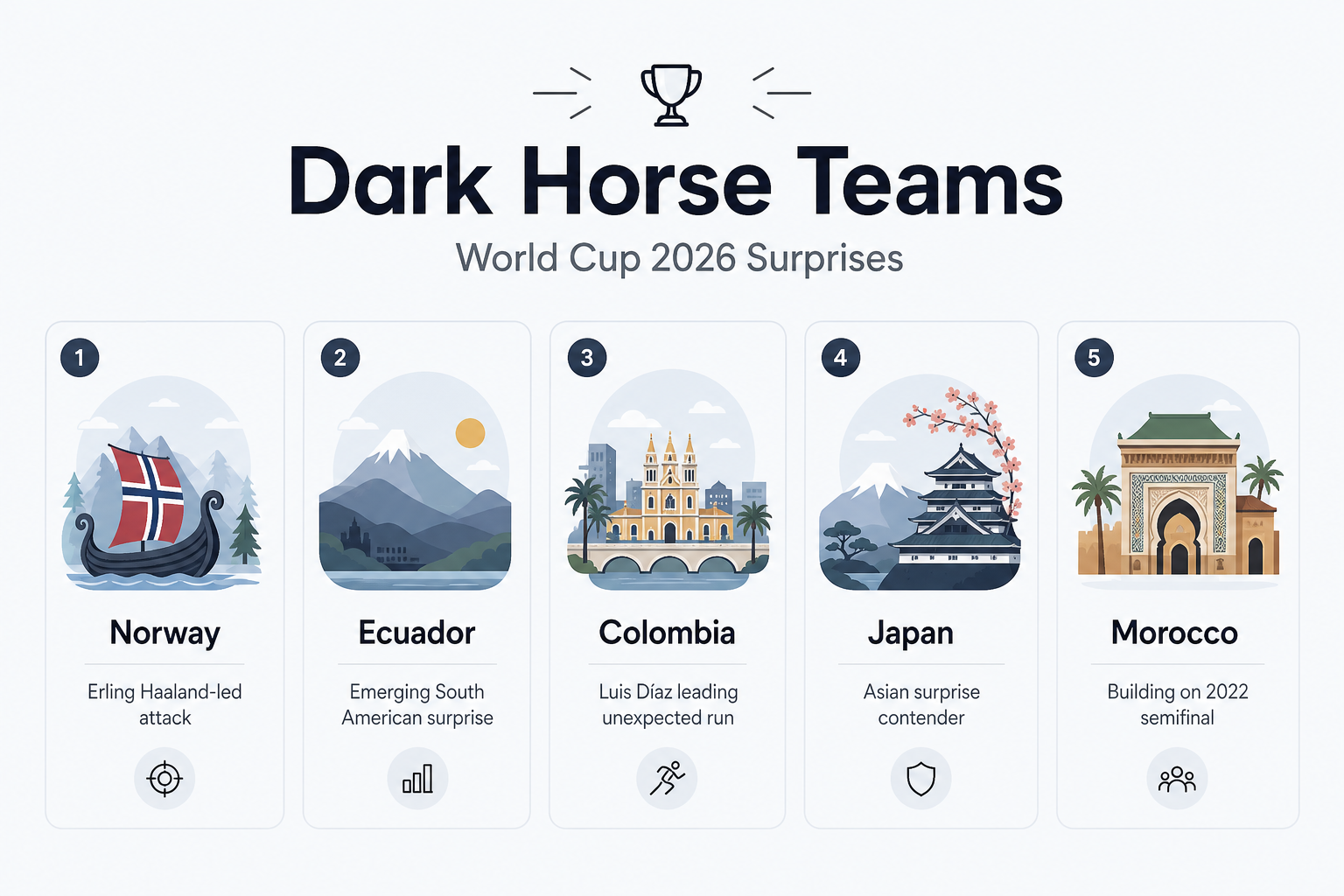
Norway, led by the prolific Erling Haaland, is emerging as a dark horse that’s shocking everyone. Nobody predicted Norway to be among the tournament’s leading scorers at this stage. With 4 goals already, Haaland is proving that the expanded format isn’t just letting weaker teams through – it’s giving genuinely talented sides a platform to make noise. Norway’s efficiency in front of goal has been remarkable. They’re not overwhelming opponents with possession; they’re lethal on the counter, and Haaland is the perfect finisher for that style. If Norway continues this trajectory, they could be a legitimate threat in the knockout round.
Colombia, Ecuador, and Japan are all performing better than expected, showing that the increased number of group matches is creating genuine competitive balance. It’s not just the raw expansion – it’s that these teams have been given time to settle into the tournament, to learn from their matches, and to adjust their tactics. Morocco, building on their 2022 semifinal run, is again punching above expectations, which proves that the 2022 World Cup run in Qatar wasn’t a fluke – Morocco has genuinely established itself as a tournament-caliber team.
The other major story? Cristiano Ronaldo has made history at the 2026 World Cup, with a notable performance that’s reminded everyone why he remains one of football’s most dangerous players, even as he enters the latter stages of his career. The rivalry between Ronaldo and Messi for all-time goalscoring records has been one of football’s defining narratives, and both are writing new chapters at this World Cup.
Dark horses and breakout stars
The expanded format has really opened the door for unexpected performances. Beyond Haaland’s emergence at the scoring table, there are players and teams that came into the tournament as long shots and are now making genuine noise.
Ecuador is delivering surprises as an emerging South American contender, while Colombia is building around Luis Díaz’s attacking brilliance. Japan is proving to be the Asian surprise team worth watching, and they’ve got the kind of technical quality and pace that could trouble any team in the knockout round.
Then there’s the story of individual breakout performances. Players like Deniz Undav (Germany) and Jonathan David (Canada) have used the group stage as a platform to announce themselves on the world’s biggest stage. These are the kinds of performances that catch scouts’ attention and can change transfer markets in the months that follow.
What to watch next
The group stage still has crucial matches ahead, and the storylines are only getting tighter. With Portugal vs. Colombia coming up on June 27, we’re entering the final stretch of group play where finishing positions in groups will start to matter significantly for the knockout bracket.
The race for the Golden Boot is still genuinely wide open – Messi’s 5-goal lead is comfortable but far from insurmountable if Mbappé or Haaland find another gear in their remaining group matches. Both players have shown the clinical finishing to go on scoring runs at any moment, which is what makes this race so compelling. If any of these three manage to sustain their scoring pace through the knockout stage, they could be looking at 6+ goals, which is championship-level performance.
The dark horses we’ve mentioned – Norway, Colombia, Ecuador – will be crucial to watch as their group stage matches intensify. A single upset result can dramatically shift how the bracket plays out, and in an expanded 48-team format, there’s more of a path for surprise teams to make knockout runs than ever before. That’s the beauty of the new format – it genuinely opens the door for Cinderella stories.
Keep an eye on faston.click for live scores as these matches unfold – the next few days will determine a lot about which teams make deep tournament runs and which ones go home with regrets. The group stage might seem like a predictable parade of matches, but we’re already seeing it determine major storylines that’ll echo through the entire tournament.
Try faston.click
If you’re the kind of person who needs to know the moment a World Cup goal lands – or who wants to keep tabs on every shock result – faston.click is the live scores platform built exactly for moments like this. Real-time updates across every competition, clean interface, and the kind of immediacy that keeps you locked in without having to refresh constantly. Whether you’re tracking the Golden Boot race or picking dark horses to surprise the tournament, faston.click keeps you across every goal, every upset, and every statistic that matters.
Frequently Asked Questions
Who is leading the FIFA World Cup 2026 Golden Boot race?
Lionel Messi is at the top with 5 goals, making him the all-time leading goalscorer in FIFA World Cup history. Kylian Mbappé (France) and Erling Haaland (Norway) are close behind with 4 goals each.
Which group stage match is predicted to be the best game of the tournament?
Portugal vs. Colombia stands out as the combination of stakes, quality, atmosphere, and stylistic contrast. Both teams have the talent to make deep runs, and the match has major bracket implications.
What is the biggest surprise so far at the 2026 World Cup?
Cristiano Ronaldo has made history with his World Cup 2026 performance. Additionally, dark horses like Norway, led by Erling Haaland, are delivering shocking performances that weren’t expected before the tournament.
Has Kylian Mbappé won a Golden Boot before?
Yes – Mbappé won the Golden Boot at the 2022 World Cup and is chasing the first-ever second Golden Boot in tournament history, something no player has achieved before.
Why is the 2026 World Cup format different?
The 2026 FIFA World Cup is the first to feature an expanded 48-team format (up from 32), which means more matches, more drama, and more opportunities for upsets. The tournament is hosted jointly by the United States, Canada, and Mexico.