History of World Cup winners: every champion from 1930 to 2026
Every FIFA World Cup winner from Uruguay in 1930 to the 2026 tournament – complete list of champions, final scores, top scorers, and the stories that shaped history.
July 11, 2026 · 14 min read
TL;DR
Eight nations have lifted the FIFA World Cup across 22 completed tournaments – Brazil leads with five, Germany and Italy have four each, Argentina three, France and Uruguay two apiece, with England and Spain holding one each. The 2026 edition in the USA, Canada, and Mexico is the first to feature 48 teams and three host countries, with the final set for MetLife Stadium on July 19, 2026. Whether you want the complete winners list, the greatest stories, or the record-breakers, you’ll find it all below.
The complete World Cup winners list (1930–2022)
Here is every champion, runner-up, final score, host country, and top scorer in tournament history.
| Year | Host | Champion | Runner-Up | Final Score | Top Scorer (Goals) |
|---|---|---|---|---|---|
| 1930 | Uruguay | Uruguay | Argentina | 4–2 | Guillermo Stábile, ARG (8) |
| 1934 | Italy | Italy | Czechoslovakia | 2–1 (aet) | Oldřich Nejedlý, TCH (5) |
| 1938 | France | Italy | Hungary | 4–2 | Leônidas, BRA (7) |
| 1950 | Brazil | Uruguay | Brazil | 2–1* | Ademir, BRA (9) |
| 1954 | Switzerland | West Germany | Hungary | 3–2 | Sándor Kocsis, HUN (11) |
| 1958 | Sweden | Brazil | Sweden | 5–2 | Just Fontaine, FRA (13) |
| 1962 | Chile | Brazil | Czechoslovakia | 3–1 | Multiple players (4) |
| 1966 | England | England | West Germany | 4–2 (aet) | Eusébio, POR (9) |
| 1970 | Mexico | Brazil | Italy | 4–1 | Gerd Müller, WGE (10) |
| 1974 | West Germany | West Germany | Netherlands | 2–1 | Grzegorz Lato, POL (7) |
| 1978 | Argentina | Argentina | Netherlands | 3–1 (aet) | Mario Kempes, ARG (6) |
| 1982 | Spain | Italy | West Germany | 3–1 | Paolo Rossi, ITA (6) |
| 1986 | Mexico | Argentina | West Germany | 3–2 | Gary Lineker, ENG (6) |
| 1990 | Italy | West Germany | Argentina | 1–0 | Salvatore Schillaci, ITA (6) |
| 1994 | USA | Brazil | Italy | 0–0 aet (3–2 pens) | Oleg Salenko & Hristo Stoichkov (6 each) |
| 1998 | France | France | Brazil | 3–0 | Davor Šuker, CRO (6) |
| 2002 | South Korea/Japan | Brazil | Germany | 2–0 | Ronaldo, BRA (8) |
| 2006 | Germany | Italy | France | 1–1 aet (5–3 pens) | Miroslav Klose, GER (5) |
| 2010 | South Africa | Spain | Netherlands | 1–0 (aet) | Thomas Müller, GER (5) |
| 2014 | Brazil | Germany | Argentina | 1–0 (aet) | James Rodríguez, COL (6) |
| 2018 | Russia | France | Croatia | 4–2 | Harry Kane, ENG (6) |
| 2022 | Qatar | Argentina | France | 3–3 aet (4–2 pens) | Kylian Mbappé, FRA (8) |
*1950 used a final round-robin format; this was the decisive match.
Titles by nation
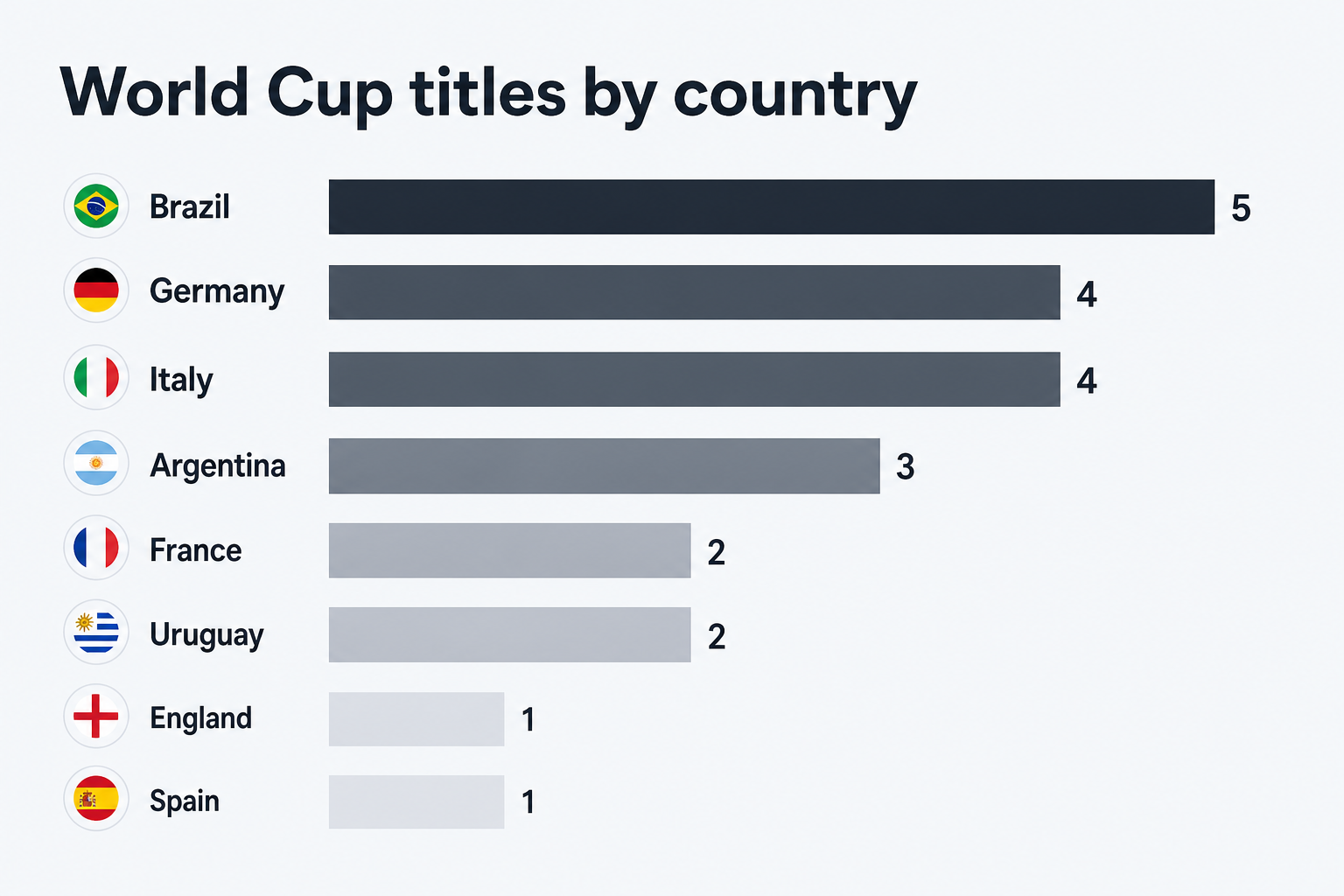
Eight countries have won football’s biggest prize across 22 editions. The gap between Brazil and everyone else remains wide.
| Nation | Titles | Years |
|---|---|---|
| Brazil | 5 | 1958, 1962, 1970, 1994, 2002 |
| Germany* | 4 | 1954, 1974, 1990, 2014 |
| Italy | 4 | 1934, 1938, 1982, 2006 |
| Argentina | 3 | 1978, 1986, 2022 |
| France | 2 | 1998, 2018 |
| Uruguay | 2 | 1930, 1950 |
| England | 1 | 1966 |
| Spain | 1 | 2010 |
*Includes West Germany titles (1954, 1974).
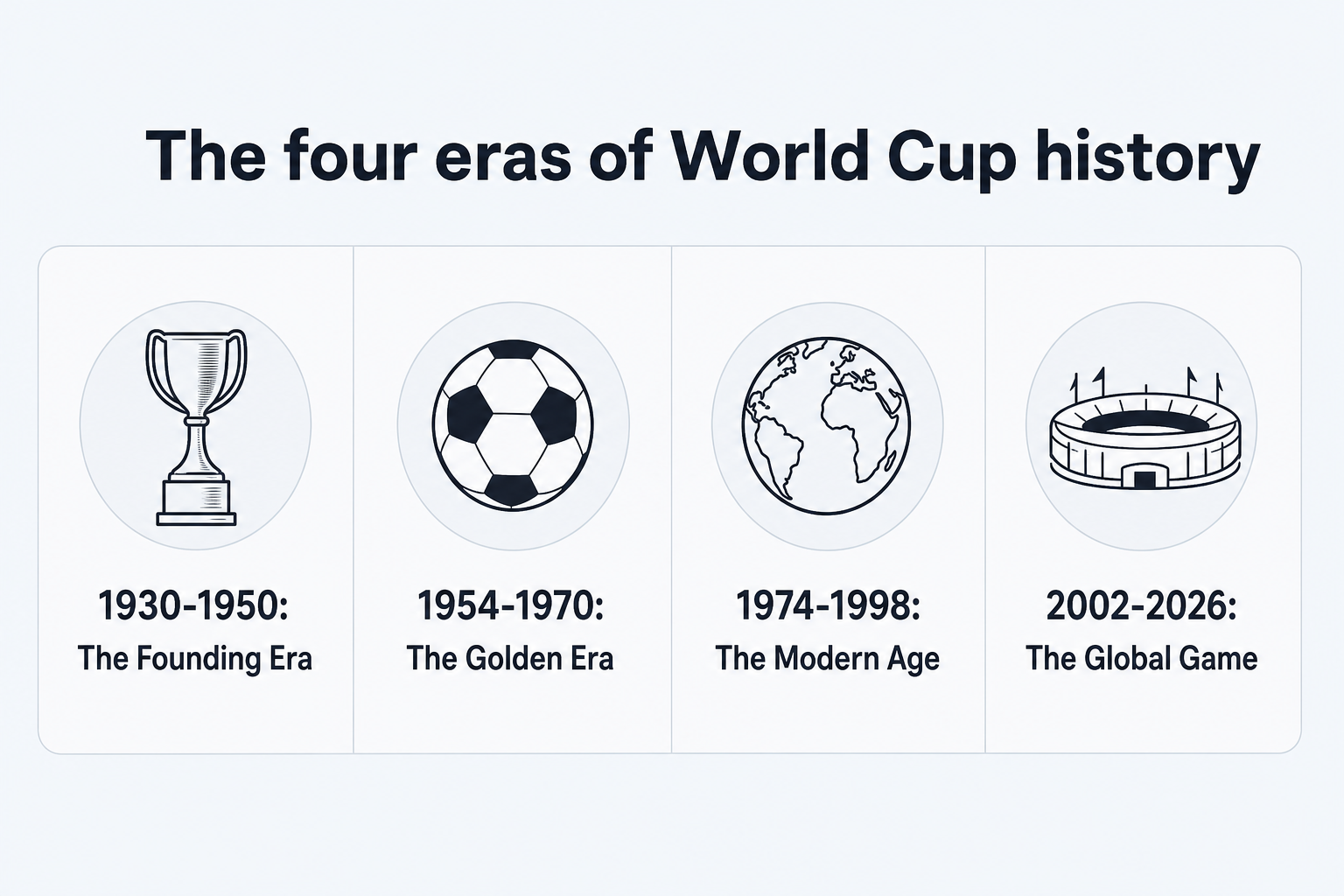
The four eras of World Cup history
The tournament looks completely different depending on which decade you land in. We can break 96 years of football into four fairly clean chapters.
The founding era (1930–1950)
The first three tournaments are really a different sport. No qualifying drama, no global TV audiences – just 13 countries on a boat to Uruguay for a tournament that felt, at the time, like a regional experiment.
1930 – Uruguay, the first champions. Jules Rimet’s dream became reality at Estadio Centenario in Montevideo. Uruguay beat Argentina 4-2 in front of 68,346 fans – after trailing 2-1 at half-time. Guillermo Stábile of Argentina finished top scorer with 8 goals despite his country losing the final. Only 13 nations participated; European teams mostly stayed home due to the cost and time of crossing the Atlantic.
1934 – Italy’s first title. Benito Mussolini’s Italy hosted and won, beating Czechoslovakia 2-1 after extra time in Rome. Uruguay, the defending champions, refused to participate in protest at the European boycott of 1930 – a grudge that shaped the tournament’s atmosphere. Giuseppe Meazza was the standout player for the Italians.
1938 – Italy again. France hosted the last pre-war tournament. Italy became the first nation to retain the title, beating Hungary 4-2. Brazil’s Leônidas was the tournament’s top scorer with 7 goals and the most thrilling player – only for team management to rest him for the semifinal against Italy, a decision that backfired badly.
1950 – The Maracanazo. The tournament resumed after a 12-year gap forced by World War II. Brazil built the Maracanã Stadium specifically for the occasion and used a final-round robin format instead of a single final. The decisive match came down to Brazil vs. Uruguay, with an estimated 173,850 people inside the ground (many claim nearly 200,000 were there). Brazil needed only a draw. Uruguay scored twice in the second half to win 2-1. The silence that fell on Rio de Janeiro afterward became known as the “Maracanazo” – still widely regarded as the greatest sporting upset in history.
“The only things that have never died in Uruguay are football and the memory of 1950.” – traditional Uruguayan football saying, referenced in Matador Network’s defining World Cup moments
The golden era (1954–1970)
These four editions gave us the sport’s mythology. Pelé. The Miracle of Bern. Total Football beginning to take shape. Goals flowing freely. This is the World Cup that built the global religion.
1954 – The Miracle of Bern. Hungary’s Magical Magyars were the greatest team on earth – 32 matches unbeaten, 6-3 and 7-1 demolitions of England. They’d already beaten West Germany 8-3 in the group stage. In the final at Wankdorf Stadium, Germany led 2-0, Hungary equalized, then Germany scored the winner 10 minutes from time. Sándor Kocsis finished with 11 tournament goals – a record that stood for 68 years until Mbappé threatened it in 2022. What happened remains one of sport’s great mysteries, with some pointing to stimulants found in injection vials near the German dressing room post-match.
1958 – Pelé arrives. In Sweden, a 17-year-old from Santos took the world by storm. Pelé scored 6 goals including a hat-trick in the semifinal against France and two in the final, as Brazil destroyed Sweden 5-2. France’s Just Fontaine scored 13 goals in 6 matches – a record that has never been challenged in the 65+ years since. Brazil played with joy, creativity, and physical excellence in a way the world had never seen at this level.
1962 – Brazil defends. Without an injured Pelé for most of the tournament, Garrincha carried Brazil to a 3-1 victory over Czechoslovakia in the final in Chile. Pelé played two games before a muscle strain ended his tournament; Garrincha was named the best player. The top-scorer prize was shared among six players – all on 4 goals – which tells you something about how tight the football was.
1966 – England’s only title. At Wembley Stadium, in front of 96,924 fans, England beat West Germany 4-2 after extra time. Geoff Hurst scored three – the only hat-trick in a World Cup final. The second Hurst goal, which struck the underside of the crossbar and bounced down, is still disputed by Germans. Portugal’s Eusébio was the tournament’s top scorer with 9 goals and its finest individual, but his team fell to England 2-1 in the semifinals.
1970 – The greatest team ever? Brazil in Mexico is the standard against which all World Cup performances are measured. With Pelé, Jairzinho, Rivelino, and Tostão, they won every match and beat Italy 4-1 in the final – Jairzinho scoring in every game, a record that still stands. Brazil was allowed to keep the Jules Rimet Trophy permanently after their third win, so a new trophy was commissioned. Gerd Müller of West Germany finished with 10 goals – the highest tally any European has achieved at a single tournament.
The modern age (1974–1998)
European football asserted dominance. Tactics became more organized, defenses tighter, and the Netherlands’ “Total Football” philosophy changed how the world thought about the game – even though the Dutch never quite won it.
1974 – Total Football falls short. Johan Cruyff’s Netherlands were the tournament’s most brilliant side, introducing the world to a fluid, interchangeable pressing system. They beat Brazil in the second group stage and reached the final as favorites. West Germany, playing on home turf, took the lead with a penalty before the Dutch had touched the ball. Netherlands equalized, then Germany won 2-1 with Gerd Müller scoring the winner – his 68th international goal. Franz Beckenbauer lifted the trophy as captain; he later became the only person to win the World Cup as both captain and manager.
1978 – Argentina’s first. The host nation won it for the first time, but the tournament is remembered as much for its politics as its football. With a military junta governing the country, Argentina needed to beat Peru by 4 goals in their final group game to reach the final ahead of Brazil. They won 6-0; accusations of a fixed match have circulated ever since. In the final, Argentina beat the Netherlands 3-1 after extra time. Mario Kempes scored twice.
1982 – Italy and a golden generation. Spain hosted 24 teams for the first time. Italy lost twice in the group stage, then went on to win the tournament – Paolo Rossi scoring hat-tricks and stunning goals en route to a 3-1 final win over West Germany. Diego Maradona’s Argentina were knocked out early; his time was coming.
1986 – The Hand of God. Mexico hosted the tournament after Colombia withdrew. Diego Maradona delivered arguably the greatest single-tournament performance in football history. His quarter-final against England produced both the most controversial goal ever (punching the ball into the net with his left hand – “the Hand of God”) and the greatest goal ever scored (dribbling past five players and the goalkeeper from inside his own half). Argentina beat West Germany 3-2 in the final. England’s Gary Lineker took the Golden Boot with 6 goals.
1990 – Defensive football dominates. Italia 90 averaged the lowest goals per game in World Cup history – 2.21. West Germany won their third title with a penalty from Andreas Brehme against Argentina in the final. Italy’s Salvatore Schillaci emerged from relative obscurity to win the Golden Boot with 6 goals. The tournament’s defining image was Paul Gascoigne’s tears; its legacy was a rule change – the back-pass to goalkeeper was banned in 1992 as a direct result.
1994 – Brazil’s fourth. The United States hosted for the first time, playing matches in nine cities across the country. Roberto Baggio carried Italy to the final almost single-handed, only to miss the decisive penalty in the shootout, sending Brazil to their fourth title. The final – 0-0 after 120 minutes, decided on penalties – was the least entertaining final in history, but the football around it was superb.
1998 – France at home. The tournament expanded to 32 teams for the first time. A young French side with Zinedine Zidane at its heart destroyed Brazil 3-0 in the final at Stade de France, with Zidane scoring twice with headers – extraordinary for someone rarely known as an aerial threat. Brazil’s preparation was reportedly thrown into chaos when Ronaldo suffered a convulsion the night before the final; he played but was a ghost of himself.
The global game (2002–2022)
The tournament went beyond its traditional centers. Africa hosted for the first time. Asia co-hosted. The FIFA World Cup became truly worldwide in scope, not just in participation.
2002 – Japan and South Korea. Football went to Asia for the first time, with South Korea reaching the semifinals as host – defeating Spain and Italy along the way, controversially. Ronaldo returned from years of injury problems to score 8 goals and win the Golden Boot, while Brazil won 2-0 in the Yokohama final over Germany. Ronaldo’s celebration haircut became one of sport’s most referenced images.
2006 – Zidane’s farewell. Germany hosted and created a party atmosphere that transformed its image. Italy won their fourth title on penalties over France in Berlin. Zinedine Zidane played his final professional match – scoring a Panenka penalty, then being sent off for headbutting Marco Materazzi in extra time. Miroslav Klose began his march toward all-time scoring records.
2010 – Africa’s moment. South Africa became the first African nation to host the World Cup. Spain dominated world football with their tiki-taka possession game, winning the tournament with a single Andres Iniesta goal in extra time against the Netherlands. The vuvuzela became the sound of the tournament and polarized opinion everywhere. Spain’s win completed an extraordinary run: European Championship in 2008, World Cup 2010, European Championship 2012.
2014 – Germany’s revenge. Brazil hosted again, 64 years after the Maracanazo. It didn’t go better. The Germans demolished Brazil 7-1 in the semifinal – a result that shocked football so deeply that the word “Mineirazo” joined “Maracanazo” in football’s vocabulary. Germany then beat Argentina 1-0 in the final, with Mario Götze scoring the winning goal as a substitute in extra time. Colombia’s James Rodríguez scored 6 goals including a stunning volley against Uruguay to win the Golden Boot and announce himself to the world.
2018 – France’s second. Russia hosted a tournament remembered for giant-killing and Luka Modric’s brilliance. Croatia reached their first final, beating Argentina, England, and Russia before losing 4-2 to France in Moscow. Kylian Mbappé became the second teenager after Pelé to score in a World Cup final. Harry Kane’s 6 goals won him the Golden Boot. Didier Deschamps became only the third person to win the World Cup as captain and then manager (after Beckenbauer and Mario Zagallo).
2022 – Qatar and the greatest final. The first World Cup in the Middle East, Qatar delivered the most extraordinary final in the tournament’s history. Argentina vs France: 2-0 down at 80 minutes, Mbappé scored twice in 97 seconds to level it – then scored a third in extra time to make it 3-3. Lionel Messi added another in extra time too. Argentina won 4-2 on penalties. Mbappé’s 8 goals won him the Golden Boot despite being on the losing side. Saudi Arabia’s 2-1 win over Argentina in the group stage was one of the tournament’s biggest ever upsets.
“I think the 2022 final was the best ever. As a football fan, it had everything.” – Didier Deschamps, France manager, post-match press conference
Golden Boot records: the all-time top scorers
The scoring records tell their own story about how football – and defending – has evolved.
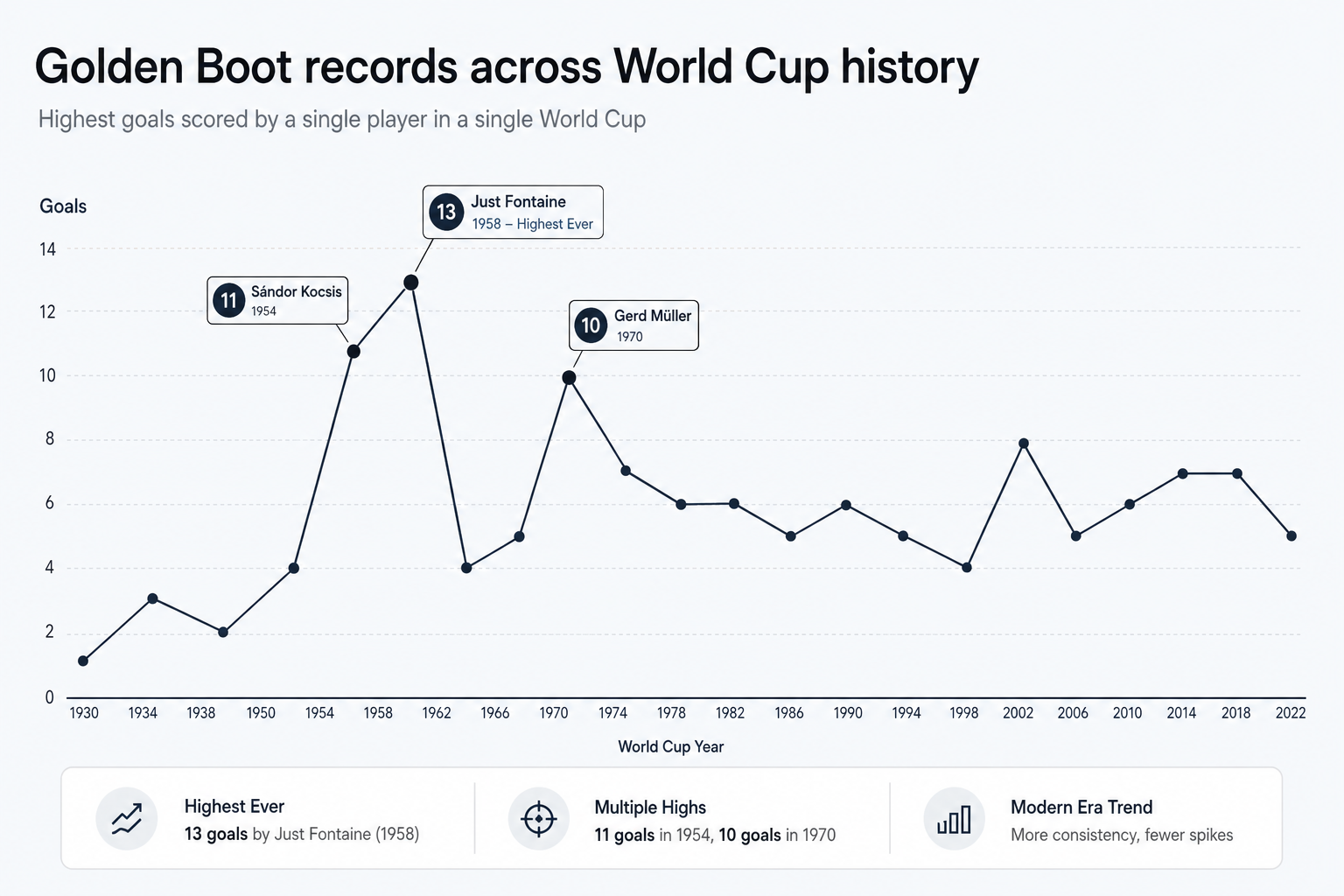
Just Fontaine’s 13 goals in 1958 remains the highest tally anyone has scored in a single tournament. He did it in six matches, averaging over two goals per game. The record looks increasingly unbreakable: Kylian Mbappé’s 8 goals in 2022 is the closest any modern player has come, and even that felt like a miracle given the defensive organization of top teams today.
The top scorers across all tournaments combined, sorted by career totals:
| Player | Country | Career World Cup Goals | Tournaments |
|---|---|---|---|
| Miroslav Klose | Germany | 16 | 2002, 2006, 2010, 2014 |
| Ronaldo | Brazil | 15 | 1994, 1998, 2002, 2006 |
| Gerd Müller | West Germany | 14 | 1970, 1974 |
| Just Fontaine | France | 13 | 1958 |
| Pelé | Brazil | 12 | 1958, 1962, 1966, 1970 |
| Jürgen Klinsmann | Germany | 11 | 1990, 1994, 1998 |
| Sándor Kocsis | Hungary | 11 | 1954 |
| Kylian Mbappé | France | 12 | 2018, 2022 |
Mbappé’s 12-goal total at two tournaments makes him one of the most prolific scorers in tournament history while still in his mid-twenties – a feat that opens up the possibility of Klose’s all-time record (16 goals) being challenged at 2026 and beyond.
The biggest shocks and defining moments
Some stories from the World Cup go beyond the result.
The Maracanazo (1950). Already covered above – but it deserves restating. Brazil, the heavy favorites, playing at home, in the world’s largest stadium, against Uruguay. Uruguay won 2-1. João Saldanha later called it “the day Brazil stopped breathing.” The Brazilian Football Confederation mourned by changing their white shirt to yellow – the color we associate with them today.
The Miracle of Bern (1954). Hungary hadn’t lost in 32 international matches. They’d beaten England twice, including a famous 6-3 win at Wembley. They’d beaten Germany 8-3 in the group stage of the same tournament. The final result – Germany 3-2 Hungary – is still studied for what it says about tournament football versus club football, about pressure, and about one good day being enough.
Maradona’s quarterfinal (1986). The two goals in one match – the Hand of God and the Goal of the Century – were scored against England, four years after the Falklands War. The political context made it bigger than football. Maradona later admitted the handball: “a little with the head of Maradona and a little with the hand of God.”
Senegal 1-0 France (2002). The reigning champions lost to debutants Senegal in the opening match – one of the biggest opening-day upsets in tournament history. France went out in the group stage without scoring a goal.
Germany 7-1 Brazil (2014). Hosts, five-time champions, in their own country. The score at half-time was 5-0. The final whistled at 7-1 – Brazil’s biggest ever defeat. Miroslav Klose scored to become the World Cup’s all-time top scorer in that game, overtaking Ronaldo’s record of 15 goals.
Saudi Arabia 2-1 Argentina (2022). Argentina were ranked second in the world, on a 36-match unbeaten run, had just won the Copa América, and were managed by the same coach who’d brought them to the 2014 final. Saudi Arabia were ranked 51st. The win is statistically one of the most improbable results in World Cup history.
The 2026 World Cup: history in the making
The 23rd edition of the FIFA World Cup is the biggest structural change in the tournament’s history. Running from June 11 to July 19, 2026, it features:
- 48 teams – up from 32 (since 1998), expanding the field by 50%
- Three host nations – the USA, Canada, and Mexico, the first ever tri-host tournament
- 16 groups of three replaced by 12 groups of four
- 104 total matches (up from 64) across 16 cities
- The final at MetLife Stadium, East Rutherford, New Jersey, on July 19, 2026
The expansion to 48 teams means genuine World Cup debutants and smaller footballing nations get a seat at the table for the first time. Canada – co-hosting – qualified as a full participant rather than an automatic host entry. The format also creates a larger knockout phase: 32 teams reaching the Round of 32, 16 to the Round of 16, and then the standard quarterfinals through to the final.
Lionel Messi arrived as a defending champion looking to extend his World Cup legacy. Kylian Mbappé, leading France in their bid to become the first team since Brazil (1958 and 1962) to win back-to-back titles, entered as arguably the world’s best player – and with 12 career World Cup goals already at age 27, very much in striking distance of all-time records.
The quarter-finals reached as of July 10, 2026 featured France, Spain, Belgium, Norway, England, Argentina, Switzerland, and Morocco – a field that underlines just how competitive the expanded format has made the tournament’s elite rounds. Follow every match live at faston.click.
Try faston.click
Faston.click is your home for live World Cup scores, standings, group tables, and match statistics – updated in real time as the 2026 tournament progresses. Whether you want to track Argentina’s title defense, check the Golden Boot race, or follow the latest quarter-final results, it’s all there – fast and accurate, the way sports coverage should be.
Frequently Asked Questions
Which country has won the most FIFA World Cups?
Brazil leads all nations with five World Cup titles – 1958, 1962, 1970, 1994, and 2002. They are also the only team to have qualified for every single edition of the tournament. Germany and Italy are next with four titles each. For live scores and standings from the current tournament, visit faston.click.
Who has scored the most goals in a single World Cup?
France’s Just Fontaine holds the all-time record with 13 goals at the 1958 World Cup in Sweden – a mark that has stood for over 65 years. The closest anyone has come since is Sandor Kocsis (11 goals, 1954) and Gerd Muller (10 goals, 1970). Fontaine’s tally still looks untouchable in the modern era of tighter defenses.
Has any country hosted and won the World Cup in the same tournament?
Yes – Uruguay (1930), Italy (1934), England (1966), Argentina (1978), and France (1998) all won on home soil. Germany hosted in 2006 but finished third, while Brazil hosted in 2014 and suffered their infamous 1-7 semifinal defeat to Germany, then lost the third-place match too.
What is the biggest upset in World Cup history?
The Maracanazo of 1950 is widely regarded as football’s greatest shock. Uruguay beat Brazil 2-1 in the decisive final round-robin match in front of an estimated 199,000 fans at the Maracana. The 1954 ‘Miracle of Bern’ – West Germany beating the unbeaten Magical Magyars 3-2 – runs it close. More recently, Japan’s win over Germany in 2022 sent shockwaves through Qatar.
What changed for the 2026 World Cup?
The 2026 tournament is the biggest structural change in World Cup history: 48 teams instead of 32, co-hosted across the USA, Canada, and Mexico – making it the first three-nation host. Teams are split into 12 groups of four, with the top two plus the eight best third-place teams advancing. The tournament runs June 11 to July 19, 2026, with the final at MetLife Stadium in New Jersey. Follow the action live at faston.click.