
Lionel Messi Argentina statistics: goals, assists, and the complete record
A complete breakdown of Lionel Messi’s Argentina stats – 180+ caps, 97+ goals, 3 major trophies, and the numbers behind one of football’s greatest international careers.
June 24, 2026 · 10 min read
TL;DR
Lionel Messi played 180+ internationals for Argentina between 2004 and 2024, scoring 97+ goals at a rate of roughly one every two games – making him the country’s all-time leading scorer by a wide margin. He appeared in five World Cups and eight Copa Américas, won three major titles (World Cup 2022, Copa América 2021 and 2024), and earned the Golden Ball as the tournament’s best player four times across his career. If you want the complete picture – every tournament, every trophy, every milestone – this is it.
There is a version of the Messi Argentina story that almost didn’t end the way it did.
Between 2015 and 2016, Argentina lost two consecutive Copa América finals to Chile, both on penalties. In 2018, they fell to France in the round of 16. The conversation around Messi and Argentina had settled into a frustrating groove: brilliant at club level, somehow cursed at international level. Diego Maradona had his 1986. Messi, it seemed, might never get his.
Then everything changed in the span of thirteen months. The 2021 Copa América ended a 28-year Argentine drought. The 2022 World Cup delivered the title everyone had spent years doubting would ever come. By 2024, Argentina were continental champions again, and Messi had retired on his own terms, with three major trophies in four years.
The numbers behind all of it are worth sitting with properly.
Career overview: the raw numbers
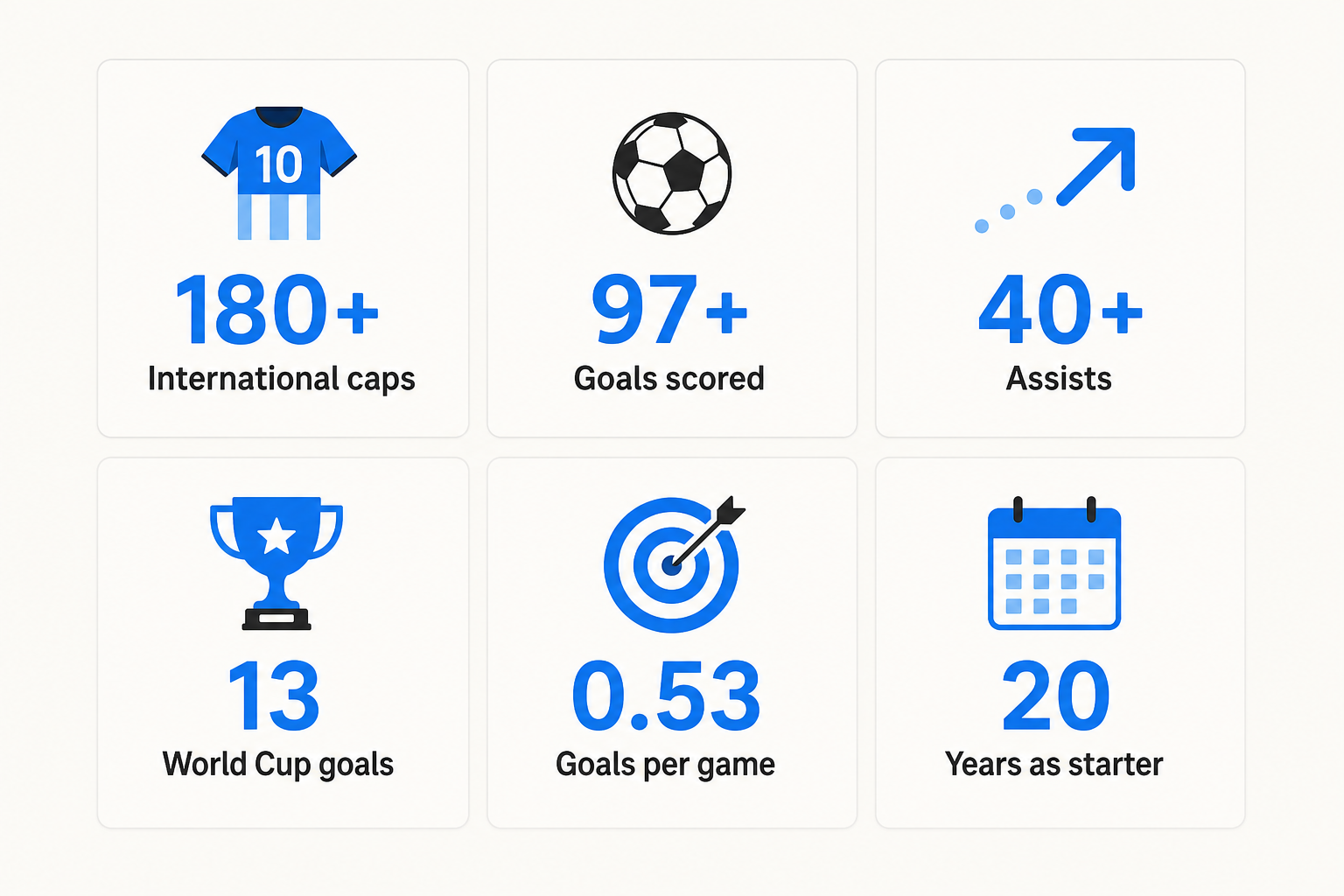
Messi’s Argentina career statistics break down like this:
| Stat | Figure |
|---|---|
| International caps | 180+ |
| Goals | 97+ |
| Assists | 40+ |
| Goals per game | ~0.53 |
| World Cup goals | 13 |
| Copa América titles | 2 |
| World Cup titles | 1 |
| Golden Ball awards | 4 |
Those 97+ goals make him Argentina’s all-time leading scorer, and it is not particularly close. His debut came on August 17, 2004, against Hungary – a teenage substitute whose first touch nearly got him sent off. His final match came in the 2024 Copa América, 20 years later, with every major prize in the game already won.
A goals-per-game ratio of 0.53 across 180+ matches is the kind of number that sounds modest until you put it in context: that is elite striker output maintained across two decades, through qualifying slogs, friendly dead rubbers, and knockout pressure alike. Across five different head coaches and four different decades of his life, the number barely moved.
The World Cup journey, tournament by tournament
The five-tournament World Cup arc is really four chapters of accumulating pain followed by one glorious release.
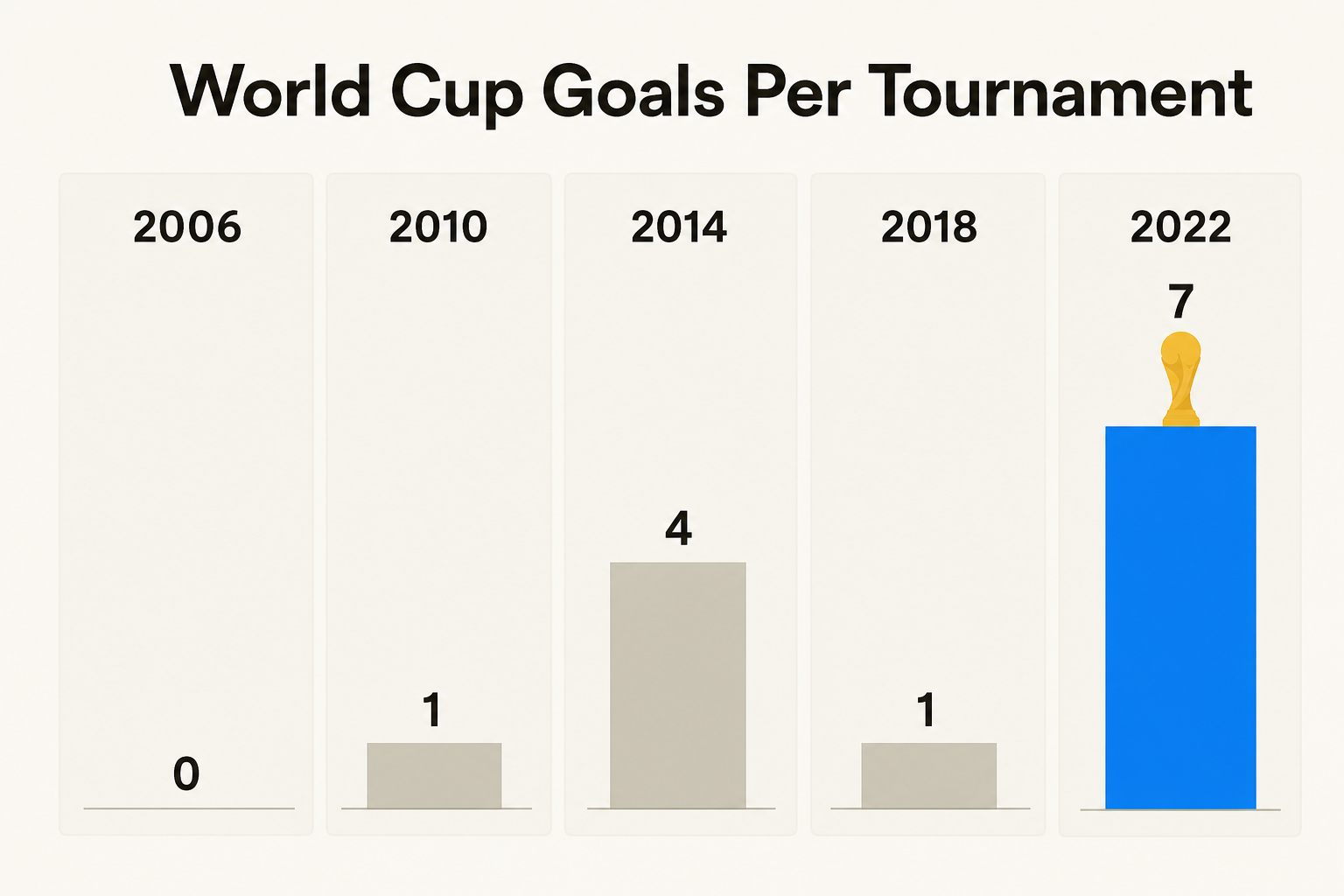
| Tournament | Goals | Assists | Apps | Result |
|---|---|---|---|---|
| 2006 Germany | 0 | 0 | Limited | QF exit |
| 2010 South Africa | 1 | Several | 5 | Final (lost) |
| 2014 Brazil | 4 | Several | 7 | Final (lost) |
| 2018 Russia | 1 | Several | 5 | R16 exit |
| 2022 Qatar | 7 | 3 | 7 | Champion |
| Total | 13 | 12+ | 25+ | 1 championship |
2006: Messi arrived in Germany at 18 as the youngest player in Argentina’s squad. He played a peripheral role, got a brief cameo in the quarter-final against Germany, and went home. The potential was obvious. The stage was not yet his.
2010: South Africa was the first real World Cup we saw Messi in command of an Argentina side. He scored against Greece in the group stage, created chances throughout, and Argentina reached the final – only to lose to a Germany side that had their number. One goal in a tournament where he was clearly the most dangerous player on the pitch. That’s the kind of mismatch between performance and output that characterized this phase of his international career.
2014: Four goals across seven matches, including a critical strike in the knockout stages as Argentina powered their way to the final in Brazil. The tournament Golden Ball for best player went to Messi – awarded to someone on the losing side, which almost never happens, and which tells you something about the gap between his individual performances and the collective result. Germany won 1-0 in extra time with a Götze goal. It remains one of the harder numbers to sit with: a Golden Ball in a World Cup final Argentina didn’t win.
2018: Russia was the low point. Argentina stuttered through the group stage, scraped past Nigeria, and were eliminated by France in the last 16 – 4-3, with Mbappé announcing himself to the world. One goal, early exit, and the narrative had solidified into something close to resignation. Messi was 30, and some people were seriously writing that this was probably his last World Cup at full capacity.
2022: Qatar changed everything.
Seven goals. Three assists. Seven appearances. A 4-2 penalty shootout victory over France in one of the greatest finals ever played – 3-3 after 120 minutes, two comebacks, a Mbappé hat-trick, and Argentina holding on through penalties. Messi scored twice in the final. He won the Golden Ball again, this time as the actual champion. At 35.
His 13 World Cup goals place him among the competition’s all-time scorers, a total spread across tournaments that ranged from breakout (2014) to defining (2022).
Copa América: from heartbreak to dynasty
The Copa América story runs on a different emotional track to the World Cup. Eight tournaments, a 28-year national drought, two consecutive finals losses to Chile – and then a run that nobody who watched would ever describe as luck.
| Year | Result | Goals | Notes |
|---|---|---|---|
| 2007 | Group exit | – | Early career |
| 2011 | Group exit | 1 | Home tournament |
| 2015 | Runner-up | 2-3 | Final lost to Chile on pens |
| 2016 | Runner-up | Multiple | Final lost to Chile on pens; tournament MVP |
| 2019 | Early exit | – | – |
| 2021 | Champion | 4 | Golden Ball; 28-year drought ended |
| 2024 | Champion | Multiple | Back-to-back titles; final matches |
The 2015 and 2016 Copa Américas hurt in a particular way. In 2016, Messi was genuinely excellent – enough to be named the tournament’s best player despite Argentina losing the final. An MVP award in a final you lost is the kind of distinction that makes football maddening. He briefly retired from international football after 2016, then reversed the decision. That’s worth noting: the decision to come back was what made 2021 and 2022 possible.
2021 remains the watershed. Argentina beat Brazil 1-0 in the final in Rio – away, in the Maracanã, against the hosts, ending 28 years without a major trophy. Messi scored 4 goals across the tournament and won the Golden Ball. The scenes afterwards – him crying with the trophy, teammates mobbing him, the Maracanã largely hostile but unable to stop what was happening – were among the most watched football images of that year.
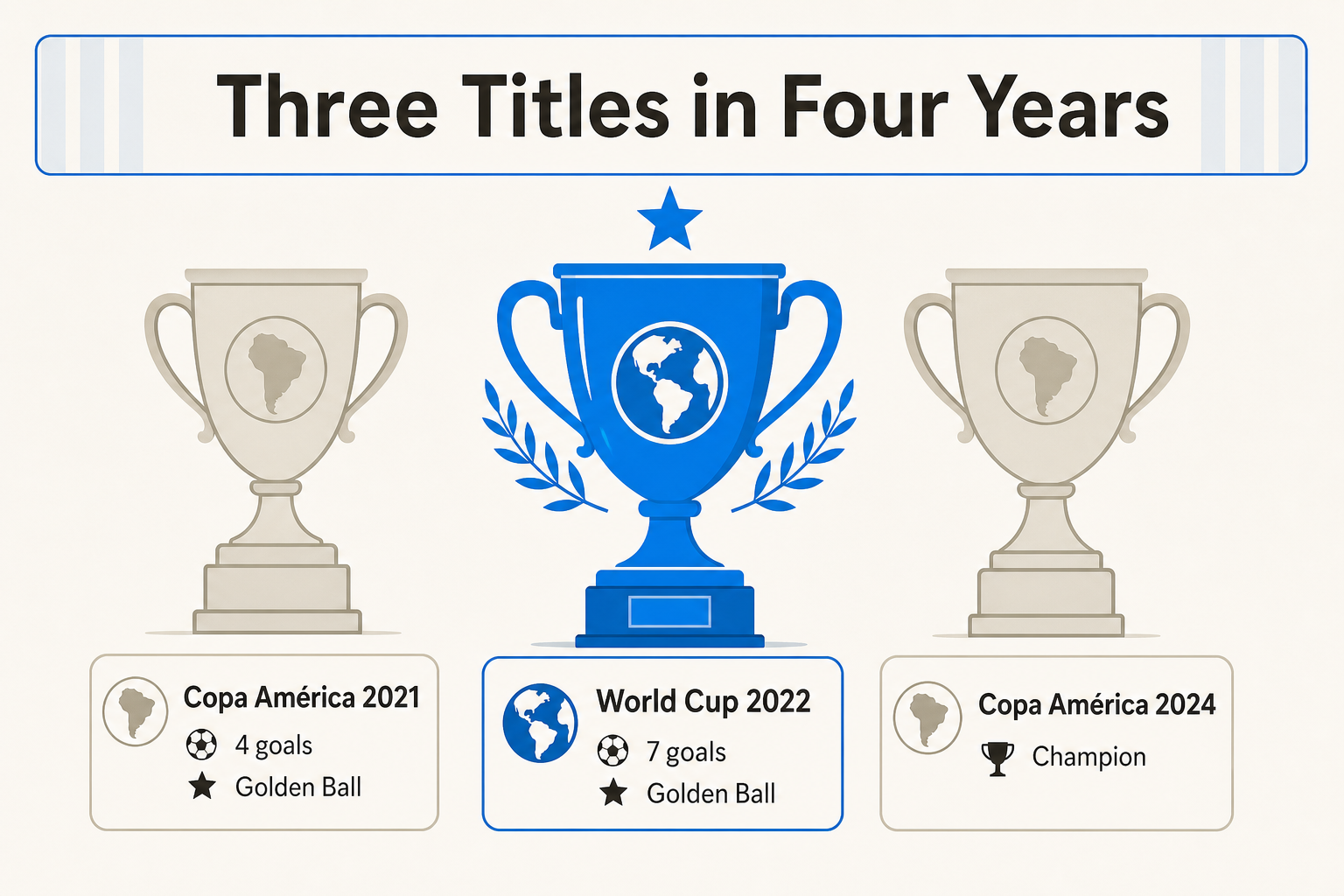
The 2024 Copa América completed the circle. Argentina defended the continental title, Messi contributed, and then – at 37 – he played his final matches for the national team. Three major trophies in four years. No ambiguity about legacy, no asterisks, no “but he never won the big one.”
“He carried us for so many years without getting the reward. Now he finally has everything. People don’t realize how much he gave just trying to get there.” – r/soccer discussion thread on Messi’s Copa América 2021 win
Records and individual honors
The individual milestones stack up in a way that makes the career feel almost structurally impossible to replicate:
- Argentina’s all-time leading scorer – 97+ international goals, surpassing the previous record by a significant margin
- Four Golden Ball awards – 2014 World Cup, 2016 Copa América, 2021 Copa América, 2022 World Cup
- Most World Cup appearances for Argentina – five consecutive tournaments spanning 16 years (2006-2022)
- Captain across multiple qualifying campaigns – led Argentina through four separate World Cup qualification cycles
- 2022 Finalissima – Argentina also won the CONMEBOL-UEFA intercontinental playoff, beating Italy, with Messi contributing to another title in what became his peak trophy-winning stretch
The Golden Ball record is particularly telling. To win it four times – twice as the champion, twice as the runner-up – is evidence of a sustained dominance that isn’t really comparable to any other player in the modern era. The two runner-up Golden Balls are almost the more remarkable ones: an individual award given to someone on the losing side says that the judging panel ran out of ways to honor the collective result separately from what one player was doing.
The goals-per-game conversation
One thing that gets lost in broad career retrospectives is how consistent the 0.53-per-game scoring rate actually was across different competition types.
In World Cup qualifying matches – often dismissed as the less glamorous end of international football – Argentina consistently scored through Messi even when the team around him was mid-table quality. His ability to produce in CONMEBOL qualifying, against well-organized defenses in high-pressure away fixtures in cities like Buenos Aires, Montevideo, and Bogotá, is part of why his goal tally is as high as it is.
Tournament football adds the asterisk of facing higher-quality defenses more consistently, which makes his Copa América and World Cup numbers – scored against the best available opposition – arguably the more meaningful measure. Thirteen World Cup goals. Twenty-one Copa América caps producing multiple goals and assists across two championship runs. The ratio holds.
Comparing Messi to Argentina’s other all-time top scorers
For context on where 97+ goals sits historically:
| Player | Goals | Caps | Era |
|---|---|---|---|
| Lionel Messi | 97+ | 180+ | 2004-2024 |
| Gabriel Batistuta | 54 | 78 | 1991-2002 |
| Sergio Agüero | 41 | 101 | 2006-2021 |
| Hernán Crespo | 35 | 64 | 1995-2007 |
| Diego Maradona | 34 | 91 | 1977-1994 |
Batistuta held the record for years and is still considered one of the purest international strikers Argentina ever produced. Messi surpassed him by a margin that makes the comparison almost difficult to make cleanly – nearly double the tally with more than twice the appearances. Agüero, for all his brilliance, reached 41 goals from 101 caps. Messi scored 97+ from 180+, but at a higher per-game rate.
The Maradona comparison is the emotionally loaded one. Maradona has the 1986 World Cup – the greatest individual tournament performance in the competition’s history – and a mythology that runs deeper in Argentina than almost any sporting figure. Messi now has more trophies, more goals, and a 2022 World Cup campaign that drew legitimate comparisons to 1986 in terms of individual impact. How those two legacies sit relative to each other is genuinely contested territory, and this article is not the place to settle it. What the numbers show is that Messi’s trophy record with Argentina, finished in 2024, is complete in a way that no one could have confidently predicted in 2016.
Following Argentina’s results live
Messi may have retired, but Argentina remain the reigning world champions and Copa América holders. If you want to follow Argentina’s scores across friendlies, World Cup 2026 qualifiers, and future Copa América campaigns, faston.click tracks live scores across all major international competitions in real time – including every South American qualifier and continental tournament.
Try faston.click
faston.click is a live football scores platform covering international and domestic matches across 10+ countries. If you follow Argentina or any other national team, it gives you real-time score updates across World Cup qualifying, Copa América, and all major competitions – updated live throughout matches.
Stats sourced from FBref international records and Wikipedia’s international career section. All figures current as of June 2026.
Frequently Asked Questions
How many goals did Messi score for Argentina?
Lionel Messi scored 97+ international goals for Argentina across his 20-year career (2004-2024), making him Argentina’s all-time leading goal scorer. He averaged approximately 0.53 goals per match across more than 180 international appearances.
How many World Cup goals did Messi score in total?
Messi scored 13 World Cup goals across five tournaments (2006-2022). His best tournament was 2022 in Qatar, where he scored 7 goals and added 3 assists as Argentina won the title, earning him a second Golden Ball award.
Did Messi win the World Cup with Argentina?
Yes. Messi won the 2022 FIFA World Cup in Qatar, defeating France 4-2 on penalties after a 3-3 draw in the final. He scored twice in the final and won the Golden Ball as tournament’s best player – at age 35.
How many Copa América titles did Messi win?
Messi won two Copa América titles with Argentina: in 2021 (defeating Brazil 1-0 in the final, ending a 28-year Argentine drought) and in 2024 (back-to-back continental championships). He won the Golden Ball in 2021 and played his final matches in 2024.
How many caps did Messi earn with Argentina?
Messi earned 180+ international caps for Argentina across more than 20 years (2004-2024), appearing in five World Cups and eight Copa América tournaments. He retired from international football following Argentina’s 2024 Copa América victory.