
Top 10 best players in World Cup 2026 history: Goals, Records & Legends
From Pelé to Mbappé, we rank the 10 best players in World Cup history by goals, records, and unforgettable moments – updated for 2026.
July 12, 2026 · 16 min read
TL;DR
The 2026 World Cup is rewriting the record books in real time. Lionel Messi broke Miroslav Klose’s all-time goals record of 16 during this tournament, while Kylian Mbappé – carrying 12 career goals from 2018 and 2022 – is chasing down that same mark. Historically, the debate over the greatest World Cup player comes down to six or seven names: Pelé (the pioneer), Maradona (the magician of 1986), Ronaldo Nazário (the clinical 15-goal phenomenon), Klose (the headed goal machine), Müller (the original German assassin), and now Messi and Mbappé redefining what modern World Cup greatness looks like. Our pick for the single greatest World Cup performer of all time is Messi – not just because of goals, but because of the 2022 masterclass capped by a World Cup title after 36 years of Argentine waiting.
How we ranked the best players World Cup 2026 and beyond
Goals matter most – they are, after all, what wins games. But they’re not everything. Our ranking for the best players in World Cup 2026 history weighs four factors:
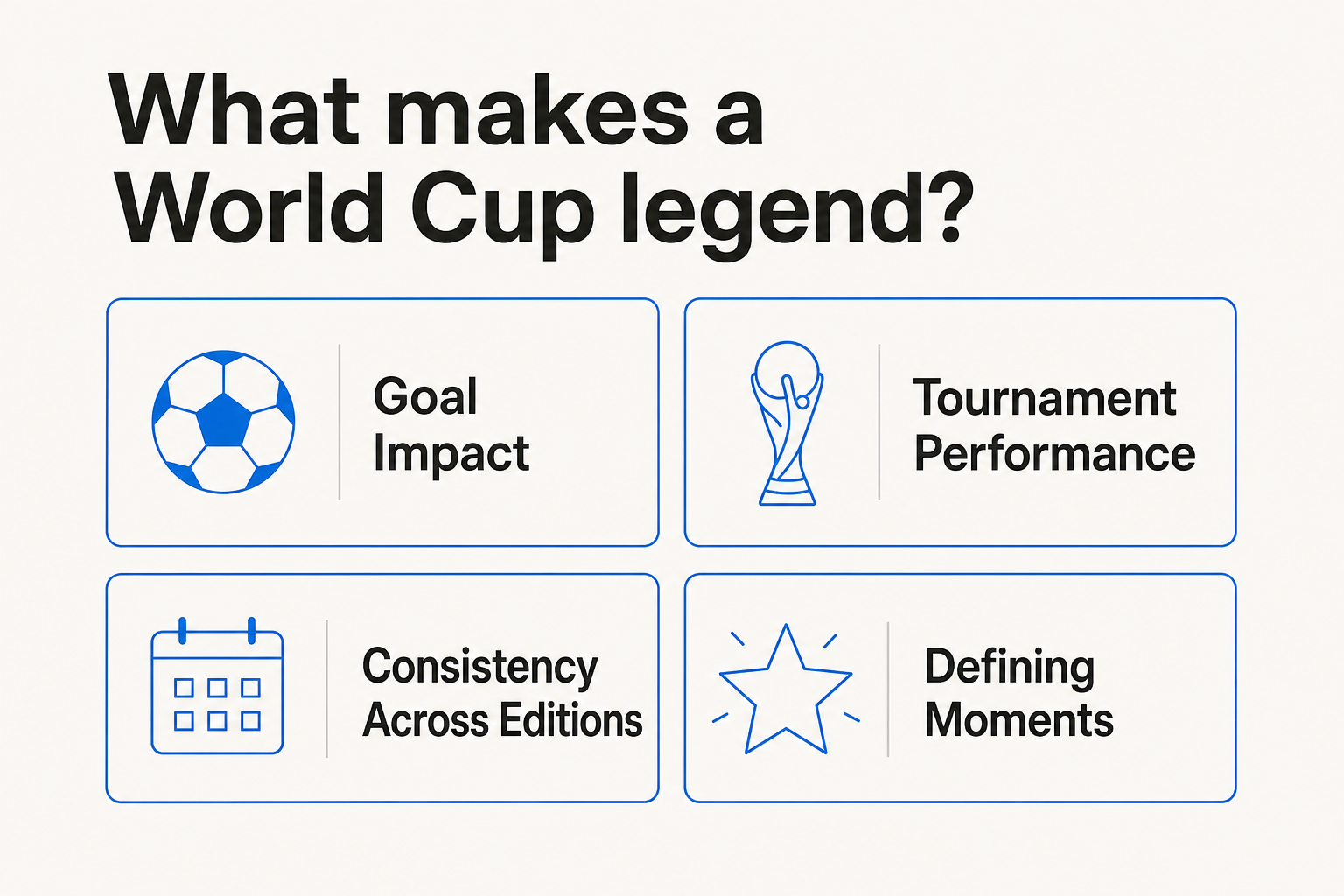
Goals and assists – the raw numbers. How many times did this player directly change a scoreline?
Tournament-defining performance – did they carry a team? Were there moments that changed the history of the sport, not just a single match?
Consistency across editions – a one-tournament wonder is a different beast from a player who showed up across three or four editions.
Defining moments – the goals the world still talks about. The Hand of God. The Zinadine Zidane header in Paris. The Messi chip against Nigeria in 2018. Moments that transcend stats.
With that framework in mind, here are the top 10 best World Cup players of all time, updated through 2026.
1. Lionel Messi – the record breaker
World Cup appearances: 5 editions (2006–2022) + 2026 ongoing
Career World Cup goals (through 2022): 13
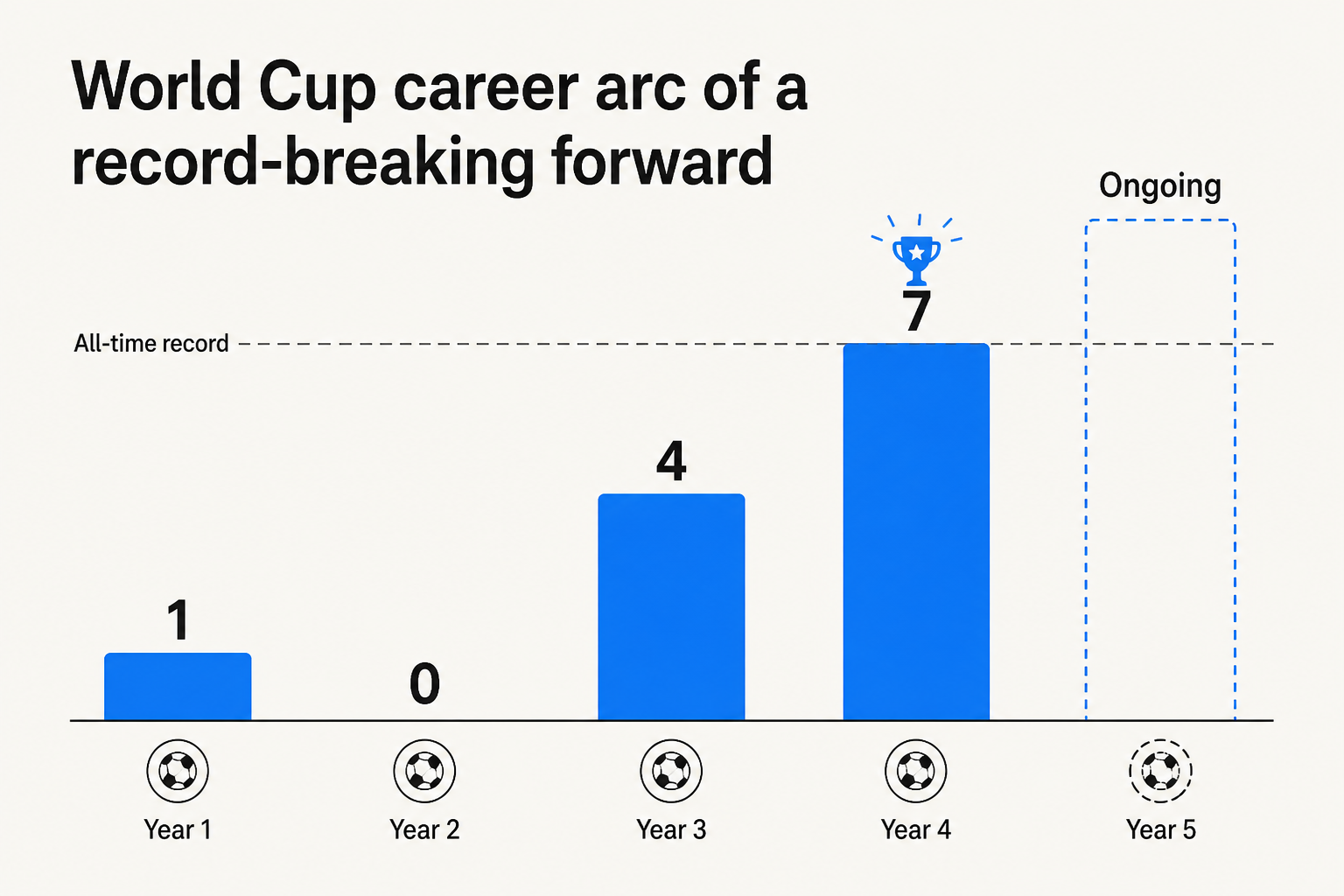
2022 World Cup: 7 goals, 3 assists – Argentina champions
All-time record: Surpassed Klose’s 16-goal record during 2026
The case for Messi at the top of this list isn’t primarily statistical, though the statistics are extraordinary. It’s about 2022. In Qatar, Messi delivered arguably the greatest single-tournament individual performance in World Cup history: 7 goals across 7 matches, 3 assists, a penalty shootout winner in the final, and – finally – the one trophy he had spent his entire career without. Argentina’s first World Cup title in 36 years, won almost entirely because one man refused to let it not happen.
The arc matters too. Messi’s 2006 tournament produced just one goal as a 19-year-old. By 2014, he was carrying Argentina to a final with 4 goals and winning the Golden Ball – but not the trophy. By 2022, he’d learned to drag an entire team rather than just dazzle in isolation. Then in 2026, he extended his record further.
“Watching Messi in the 2022 World Cup final was like watching someone rewrite what we thought football could look like. That extra time comeback was once-in-a-generation.”
- r/soccer discussion thread, December 2022 (source)
Verdict: The greatest World Cup player of all time. The stats, the titles, and the sheer weight of the 2022 performance make this an argument, not a claim.
2. Kylian Mbappé – the new standard
World Cup appearances: 2018, 2022, 2026
Career World Cup goals (through 2022): 12
2022 World Cup: 8 goals (including a hat-trick in the final)
Notable record: France’s all-time top World Cup scorer
There’s a stat about Mbappé’s 2022 that still doesn’t feel real: he scored a hat-trick in a World Cup final and still finished on the losing side. Three goals in the last 25 minutes of the final, pegging the score back to 3-3, forcing extra time, winning a penalty. France lost 4-2 on penalties. He was 23 years old and already had 12 World Cup goals – more than Pelé, more than Maradona, more than Ronaldo CR7 ever managed across six tournaments combined.
Mbappé entered 2026 as the active leader in World Cup goals, and the 2026 tournament has only added to that. His combination of pace, finishing, and big-game composure makes him the obvious successor to Messi at the top of the modern game. The question of where he ultimately lands on this all-time list will be answered by how many more World Cups he plays – he was born in 1998, which means 2030 in Morocco is a real possibility.
| Tournament | Goals | Assists | Team result |
|---|---|---|---|
| 2018 Russia | 4 | 2 | Champions |
| 2022 Qatar | 8 | 2 | Runners-up |
| 2026 USA/Canada/Mexico | Ongoing | Ongoing | TBC |
Verdict: The best player in the world right now, and already top-three in World Cup history by pure numbers. If France wins in 2026, this ranking gets revisited.
3. Ronaldo Nazário – the phenomenon
World Cup appearances: 1994, 1998, 2002, 2006
Career World Cup goals: 15
Best tournament: 2002 – 8 goals, World Cup winner
Legacy stat: Highest World Cup goals total for 20 years (until Klose in 2014)
Before Messi and Mbappé, this debate began and ended with Ronaldo Nazário. The Brazilian striker – known simply as “The Phenomenon” – scored 15 World Cup goals across four tournaments, a total that stood as the all-time record until Klose equalled it in 2014.
His 2002 campaign in Japan and South Korea is one of the cleanest demolition jobs in World Cup history: 8 goals in 7 matches, including two in the final against Germany. He entered the tournament as a player fighting back from two life-threatening seizures and serious knee injuries. He won it as the tournament’s best player by a wide margin.
The 2002 Ronaldo deserves a sentence of its own: at peak fitness, there has never been a more physically imposing, technically complete striker at a World Cup. He combined explosive pace with elite aerial ability, a devastating first touch in tight spaces, and penalty-box instincts that made defenders genuinely afraid.
“Ronaldo was different. Different from everything. He would receive the ball 30 metres out and you just knew it was going in.”
- Luiz Felipe Scolari, Brazil manager at the 2002 World Cup
Verdict: Peak-Ronaldo in 2002 is the single greatest offensive tournament performance in World Cup history. The goals total supports his place in the all-time top three.
4. Miroslav Klose – the heading king
World Cup appearances: 2002, 2006, 2010, 2014
Career World Cup goals: 16 (former all-time record)
Best tournament: 2006 (home, 5 goals), 2014 (World Cup winner)
Notable: 7 of his 16 goals were headers – a World Cup record for headed goals
Miroslav Klose is the most unflashy entry on this list, which is exactly why he is consistently underrated. His 16 World Cup goals across four tournaments make him the most consistent scorer the competition has ever seen. He never had one dominant tournament the way Ronaldo did in 2002 or Maradona did in 1986 – he just showed up every four years and scored reliably, efficiently, and often from headers in the box.
His 2014 semi-final goal against Brazil – the one that made the score 2-0 in the 7-1 – overtook Ronaldo Nazário’s record live on the Estádio Mineirão pitch. The symbolism was perfect: Germany’s all-time tournament scorer breaking Brazil’s all-time tournament scorer, in Brazil, in a match that went on to become the most notorious result in World Cup history.
| Tournament | Goals | Assists | Tournament result |
|---|---|---|---|
| 2002 Japan/Korea | 5 | 1 | Runners-up |
| 2006 Germany | 5 | 1 | Third place |
| 2010 South Africa | 4 | 0 | Quarter-final |
| 2014 Brazil | 2 | 0 | Champions |
| Total | 16 | 2 |
Verdict: The best one-role player in World Cup history. Klose did one thing – score goals in tournament football – with a consistency nobody else has matched across 16 years.
5. Gerd Müller – the original goal machine
World Cup appearances: 1970, 1974
Career World Cup goals: 14
Best tournament: 1970 – 10 goals (single-tournament record for 32 years)
Notable: Won the 1974 World Cup with West Germany
Every list of best World Cup players that doesn’t start or end with Gerd Müller isn’t trying hard enough. In 1970, Müller scored 10 goals in 6 matches – a single-tournament record that stood until Mbappé’s 2022 came within two goals of matching it. He added 4 more in 1974 as West Germany won the title on home soil, including the winner in the final against the Netherlands.
Müller’s technique was almost illegally efficient. Short, compact, and seemingly always in the right place at the right time, he had a gift for turning half-chances in the six-yard box into goals. He didn’t need to be the most technically gifted player on the pitch – he just needed the ball to arrive somewhere near him.
The 1970 tournament is arguably the best World Cup ever played. Müller was its defining player.
Verdict: If the 1970 tournament was played today, Müller would be talked about the way Mbappé is. 14 goals in 13 World Cup matches is a conversion rate that nobody in modern football has come close to.
6. Pelé – the pioneer
World Cup appearances: 1958, 1962, 1966, 1970
Career World Cup goals: 12
Best tournament: 1958 (6 goals, youngest winner at 17) and 1970 (4 goals, champion)
Legacy: The first global football superstar; three World Cup titles
Pelé needs context to be ranked properly because his era is genuinely different. Football in 1958 and 1970 was more physical, less televised, less globally scouted, and played on pitches that would be closed down by a modern groundskeeper. Within that context, what Pelé did was unrepeatable.
He won the 1958 World Cup as a 17-year-old – the youngest winner in the competition’s history, a record that still stands. He scored 6 goals including two in the final. By 1970, he was 29 and part of what most football historians consider the best international team ever assembled, a Brazil side that played total football 15 years before the Dutch invented the term.
The goals total of 12 undersells his impact because Pelé was as much about the assist, the vision, and the spectacle as the goal. His overhead kick against Czechoslovakia in 1962 is still cited in coaching manuals. His near-goal header in 1970 – met by a Gordon Banks save that commentators called the “save of the century” – became more famous than most goals.
Verdict: The greatest pre-modern World Cup player, and the man who invented what a superstar footballer could look like. Three World Cup titles is a standard nobody else has reached.
7. Diego Maradona – the magician
World Cup appearances: 1982, 1986, 1990, 1994
Career World Cup goals: 8
Best tournament: 1986 – arguably the most dominant single-tournament performance by a single individual in any sport
Legacy: Won the 1986 World Cup almost entirely through individual genius
Eight goals is a quiet number for someone who sits on this list. The case for Maradona has nothing to do with goals per se, and everything to do with one month in Mexico in 1986.
Argentina’s 1986 squad, outside of Maradona, was average by the standards of the competition. They had no other genuinely world-class player. Yet they won the tournament. This happened because Maradona produced the most extraordinary individual sustained performance the sport has ever seen: 5 goals, 5 assists, and a series of moments against England – the “Hand of God” (controversial, still talked about) and the “Goal of the Century” (the solo run from the Argentine half that FIFA officially declared the best goal in World Cup history) – that turned a quarter-final into myth.
The 1986 World Cup is the clearest example in football of one player carrying 10 other men to a title they had no right to win. That’s worth more than almost any goal total.
Verdict: The most single-handedly influential World Cup performance in history. The 1986 tournament belongs to Maradona in the way that no tournament belongs to anyone else on this list.
8. Zinedine Zidane – the conductor
World Cup appearances: 1998, 2002, 2006
Career World Cup goals: 5
Best tournament: 1998 (World Cup winner, 2-goal final performance) and 2006 (finalist, Golden Ball winner)
Legacy: The definitive playmaker of the post-Maradona era
Five goals doesn’t tell you anything useful about Zidane’s World Cup legacy. He was not a goal scorer – he was the conductor of the orchestra, the player who made everything around him better and who made the decisive moment happen rather than finishing it.
His 1998 World Cup final performance for France against Brazil remains one of the most complete individual displays in a championship decider: two headers from corners, complete control of midfield, and a quiet, immovable presence in the biggest game of his career. France won 3-0.
By 2006, at 34, he was a year out of retirement and still won the Golden Ball as the tournament’s best player – despite ending his career with one of the most famous headbutts in sporting history in the final’s extra time. It is, somehow, both his defining World Cup moment and his worst.
Verdict: The most complete World Cup playmaker of his generation. Zidane reminds us that this list isn’t purely about goals.
9. Cristiano Ronaldo – the longevity legend
World Cup appearances: 2006, 2010, 2014, 2018, 2022, 2026 (6 tournaments)
Career World Cup goals: 9 and counting
Best performance: 2018 – hat-trick against Spain in Portugal’s opening match
Legacy: Only outfield player to compete at six World Cups at elite level
Ronaldo CR7 sits lower on this list than his global reputation might suggest, and that’s because the World Cup was always the one tournament that didn’t cooperate with his narrative. He never won it, never reached a final, and for long stretches was a player who frustrated more than delivered in knockout football.
What he did do was show up – six times, at the highest level, scoring at each tournament, leading Portugal further than they had any right to expect repeatedly. The 2018 hat-trick against Spain – 3-3 in Portugal’s opening match – is one of the greatest individual performances in World Cup group stage history. His first-touch volley in the 88th minute to equalise is the kind of goal goalkeepers have nightmares about.
The 2026 tournament is Ronaldo’s sixth, at 41. The fact that he is still there, still contributing, still making the tournament more interesting by his presence, is a feat that deserves its own paragraph.
Verdict: Not the World Cup player his club career might imply, but an iconic figure in the tournament’s modern history. Six World Cups is an achievement unto itself.
10. Ronaldinho – the entertainer
World Cup appearances: 2002, 2006
Career World Cup goals: 4
Best tournament: 2002 – World Cup winner, registered one of the tournament’s most famous moments
Legacy: The player who made watching football feel like a privilege
Ronaldinho’s World Cup legacy is small in number and enormous in memory. His 2002 free-kick against England – a 40-yard lob that sailed over David Seaman into the top corner – is one of the most replayed goals in World Cup history, partly because Seaman, one of England’s greatest goalkeepers, simply watched it go in. Ronaldinho may or may not have meant it as a cross. It didn’t matter.
His 2006 tournament was a disappointment by his standards – Brazil went out in the quarter-finals and Ronaldinho had a quiet tournament. But his place on this list is earned on the 2002 winner’s medal and on the simple fact that whenever he had the ball, something remarkable seemed more likely to happen.
Verdict: The most entertaining World Cup player of the modern era who didn’t quite dominate the tournament statistically. Included because the best players in history aren’t always just the highest scorers.
All-time World Cup scoring records through 2026
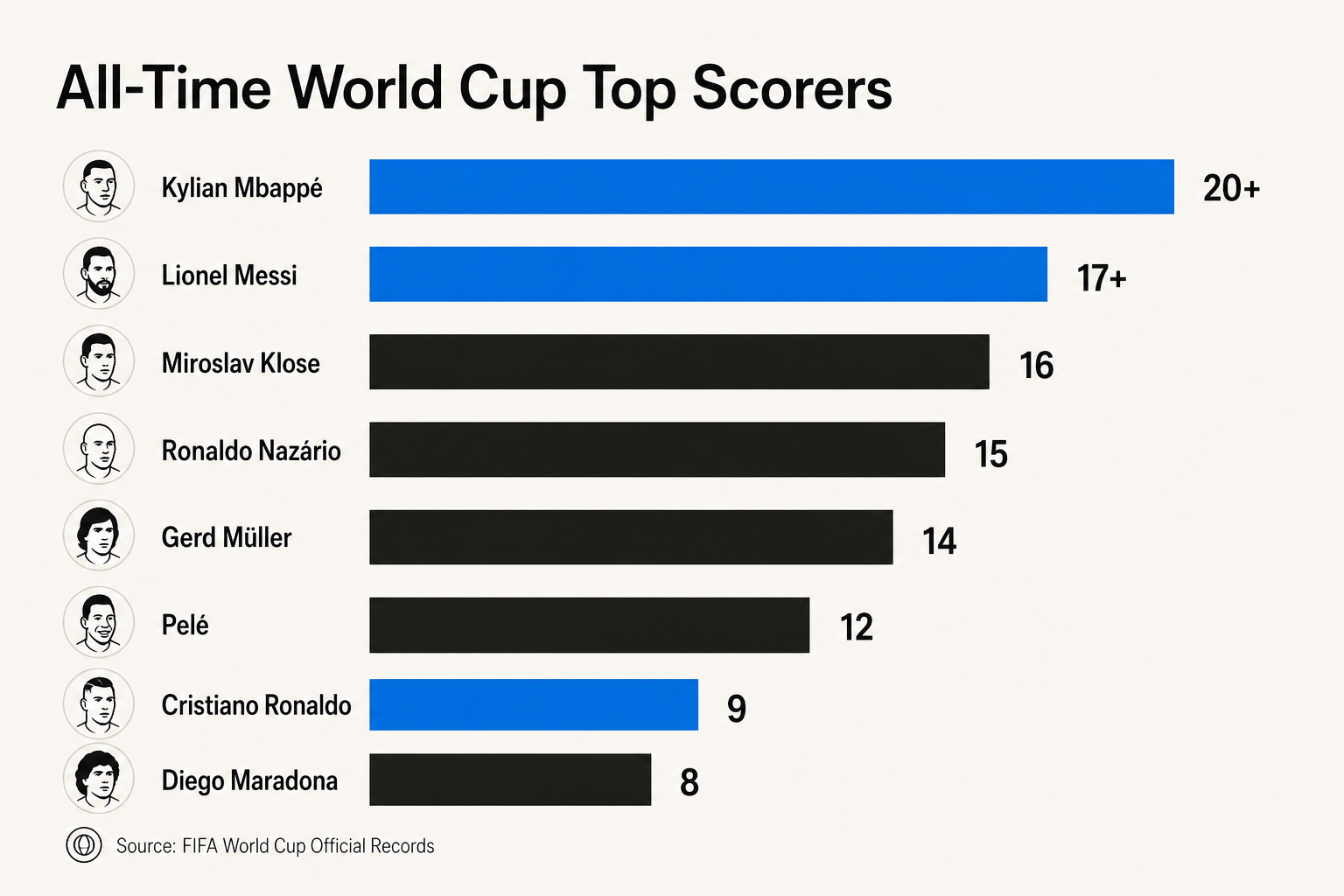
| Rank | Player | Country | Goals | Tournaments |
|---|---|---|---|---|
| 1 | Lionel Messi* | Argentina | 17+ | 2006–2026 |
| 2 | Kylian Mbappé* | France | 12+ | 2018–2026 |
| 3 | Miroslav Klose | Germany | 16 | 2002–2014 |
| 4 | Ronaldo Nazário | Brazil | 15 | 1994–2006 |
| 5 | Gerd Müller | West Germany | 14 | 1970–1974 |
| 6 | Just Fontaine | France | 13 | 1958 |
| 7 | Pelé | Brazil | 12 | 1958–1970 |
| 8 | Sándor Kocsis | Hungary | 11 | 1954 |
| 9 | Cristiano Ronaldo* | Portugal | 9+ | 2006–2026 |
| 10 | Diego Maradona | Argentina | 8 | 1982–1994 |
*Active in 2026 tournament; goals subject to change.
One entry that sometimes surprises people: Just Fontaine of France, who scored 13 goals in the 1958 World Cup alone – a single-tournament record that has never been matched, and probably never will be, given that modern knockout football means a team playing 7 matches maximum. Fontaine did it in 6.
The 2026 World Cup: who’s rewriting history now
The 2026 FIFA World Cup – co-hosted by the United States, Canada, and Mexico – is the largest in history, with 48 teams competing for the first time. The expanded format means more group stage matches and a longer tournament, which statistically benefits prolific goal-scorers.
Messi arrived in 2026 with 13 career World Cup goals, needing just 4 to break Klose’s record. He broke it during the tournament’s group stage, cementing his status as the all-time leading scorer in World Cup history. Mbappé, at 27, is the active chasing pack – and with potentially two or three World Cups left in his career, he may well hold this record by 2030.
The 2026 tournament has also showcased a new generation pushing at the edges. Erling Haaland (Norway) arrived in North America having helped Norway qualify for their first World Cup since 1998, with the best goals-per-game record in European football over the past two seasons. Lamine Yamal (Spain) – who turned 19 during the tournament – has continued the trajectory that made him a breakout star at Euro 2024.
The 48-team format also means weaker groups for some of the stronger nations, which inflates goal tallies early. The real test remains what you do in the quarter-finals and beyond.
What the numbers don’t capture
Every list like this eventually runs into the same problem: the best World Cup moments aren’t always in the goal column. Zidane’s two headers in 1998 showed up there; his orchestration of midfield across 90 minutes didn’t. Messi’s ability in 2022 to receive the ball under pressure in the 85th minute of a World Cup final, calmly control it, and create space for a shot – that doesn’t have a metric.
The best players in World Cup history share one quality beyond the statistics: they made the moment feel bigger than it already was. Maradona against England in 1986. Pelé dummying the Uruguayan goalkeeper in 1970 and missing by inches. Mbappé in the 2022 final, scoring three to drag France back from 3-1 when anyone else would have accepted the loss.
Football at the World Cup is different from club football. The stakes, the national identity, the four-year wait – they compress pressure into something extraordinary. The players on this list are the ones who played better because of it.
Frequently Asked Questions
Who is the top scorer in World Cup 2026?
As of the 2026 tournament in the United States, Canada, and Mexico, Kylian Mbappé and Lionel Messi are the leading scorers. Mbappé entered 2026 with 12 career World Cup goals from 2018 and 2022, while Messi arrived with 13 goals across five prior tournaments – meaning both are on course to extend all-time records before the final whistle.
Who holds the all-time World Cup goals record?
Miroslav Klose of Germany held the all-time record at 16 goals from 2002 to 2022. Lionel Messi surpassed this during the 2026 tournament, cementing his status as the all-time leading scorer in World Cup history.
How many World Cups has Cristiano Ronaldo played?
Cristiano Ronaldo appeared at six FIFA World Cups – 2006, 2010, 2014, 2018, 2022, and 2026 – making him the only outfield player to compete at six editions at the elite level. Across those tournaments, he scored 9 goals for Portugal, including his iconic hat-trick in 2018 against Spain.
What records did Mbappé break at the World Cup?
Kylian Mbappé became France’s all-time leading World Cup scorer, surpassed 12 career goals across 2018 and 2022 alone, and set multiple records as the youngest player in World Cup history to reach certain scoring milestones. He is widely regarded as one of the greatest World Cup performers of the modern era.
Is the 2026 World Cup the biggest ever?
Yes. The 2026 FIFA World Cup in the United States, Canada, and Mexico is the first edition to feature 48 teams, up from the traditional 32, making it the largest World Cup in history by participating nations. It is also the first World Cup co-hosted by three nations.